Tag Archives: Media

The irrationality of the Irish electorate

Irish Times editorials often characterise the Irish public as angry and irrational, responding emotionally to economic and political crises instead of pragmatically.

View from the Irish Times building

I initially wanted to write a post titled ‘The Dáil Gazette, or as its commonly known the Irish Times‘ looking generally at the how the Times’ opinion pages are so often adorned with analyses and editorials that seem to have been lifted from the crib notes to a speech at the Fianna Fáil tag-rugby club awards evening, for instance:

“THE FIANNA Fáil leadership issue will now be brought to a conclusion. Brian Cowen put it up to his critics, particularly Micheál Martin, to put or shut up.”

“The Taoiseach played a blinder in his press conference after a 48-hour consultation period with his parliamentary party last evening.”

“His message was courageous, open and democratic.”

“He hit the right note by stating that his decision to stay on as Taoiseach was in the interests of the country, not the party.” [Fianna Fáil convulsions 17/1/11]

But more specifically, I wanted to find out whether the Times’ seemingly populist calls for an early election were always immediately followed by various justifications for a delay of that necessity. For example, here is the Irish Times in December 2010 calling out for a general election:

“THE NEED for a general election at the earliest possible opportunity has increased, rather than diminished, in the aftermath of the Budget. There should be no question of a long, drawn-out debate on the Finance Bill in the New Year or waiting until special legislation on climate change or corporate donations has been adopted. The sooner the electorate is given an opportunity to shape the political future of this State, the better. We are at debt’s door and it is simply not good enough to revert to party politics.” [Election required as soon as possible, 10/12/10]

“THE SOONER a general election is called the better. Public approval for the way the State is being run has shrunk to 8 per cent while the level of dissatisfaction with the Government has ballooned to a staggering 90 per cent. Taoiseach Brian Cowen’s approval rating has shrunk to an all-time low of 14 per cent while, taken together, the Coalition parties now command a shrinking support base of 19 per cent. Such a comprehensive rejection of policies, personalities and parties should not be ignored.” [Volatile movements, 16/12/10]

However, before we get around to the difficult business of elections, there is a pressing issue at hand – a very good reason why an urgently needed election must be postponed just a little bit longer. If it’s not NAMA, or various bank nationalisations, or negotiations with the ECB and IMF, or emergency budgets etc, its the Finance Bill:

“This amounts to an unwillingness to face the electorate. Only one piece of legislation is required before the Dáil is dissolved and that is the Finance Bill. It could be enacted quickly if the political will exists.” [Edging towards a general election, 8/1/11]

“As political events unfold, it might be in the national interest for Fine Gael and Labour to agree that they would guillotine the Finance Bill through the Dáil and Seanad – if their primary aim is to have a general election as soon as possible.” [Fianna Fáil convulsions, 17/1/11]

“The Opposition parties should guillotine the passage of the Finance Bill and bring on the election.” [They are where they are now, 19/1/11]

But, trawling through the archives I was distracted by a phrase that kept popping up – ‘the angry electorate’:

“Brian Cowen will lead on. The general election may be deferred until March. But the outlook for the Government parties is so bleak that only a miracle can save them from the anger of the electorate.” [‘Looking towards a fresh start‘ 27/12/10]

The angry electorate is everywhere in the opinion pages of the Times, especially in the editorials.

“The anger and volatility of the electorate has been revealed in the latest Irish Time /Ipsos MRBI opinion poll that also shows an unprecedented shift of support between the Opposition parties as uncertainty grows about the composition and policies of the next government. The findings reflect the political turmoil that beset the State as the Government sought a financial bailout from the International Monetary Fund and the European Union; published a four-year economic plan and introduced an unpopular Budget that broadened the tax base and cut welfare payments.” [Volatile movements 16/12/10]

“The public has become angry and frustrated by the incompetence of the Government and the apparent insulation of many Oireachtas members from the realities of the daily grind.” [Facing up to the realities, 28/10/10]

“The frenzied reaction of the media was not pretty to behold but did reflect the level of anger that exists among an electorate shocked and bewildered at what is happening to the country – and the seeming inability of the Government to get to grips with it.” [Traumatised electorate deserves a leader at the top of his game, 16/09/10]

“For more than a year now, I have spent most of my working weeks mixing with people from many parts of Ireland. I have had time to gauge the public mood. There is deep anger and a feeling of helplessness; a fear of the future and a profound sense of betrayal. There is, to a worrying degree, disillusionment with the whole political system.” [FF and Greens must bow out while sanity still prevails, 13/1/11]

“Nobody has been held accountable for the damage done to the State. Public anger is palpable. Structural, indeed moral, reforms are needed.” [Holding banks to account, 15/12/10]

“At this stage, the public is so angry and disillusioned by economic mismanagement and the shenanigans of government ministers that it doesn’t really care who leads Fianna Fáil […] The anger out there is palpable.” [They are where they are now, 19/1/11]

In the last two cases, ‘the anger out there is palpable’ and ‘public anger is palpable’, it sounds as if the editor, or whoever was tasked with writing the editorial, imagines themselves trapped inside the Dáil along with the elected officials, attempting to save or salvage the country’s economy while the hounds of public opinion attempt to ram the gates with a cement truck.

This ‘anger’ is used as a unsubtle means of implying the public simply doesn’t understand economic realities. It is predicated on the assumption that the public is inherently irrational, that the reason for their disapproval of various measures, such as austerity budgets, bank guarantees and bailouts, is down to the fact they simply don’t understand there, is, no, alternative:

“[In Argentina] The failure to navigate between an angry public and the fiscal constraints of IMF conditionality cut short a dozen careers in the Argentina finance ministry in the last decade. Is this the future that awaits a potential Fine Gael-Labour coalition?” [Next government must be able to take decisions, 6/12/10]

“Growing and understandable public anger, coupled with extreme economic events, has prompted the political system to table a range of policy and legislative changes that could only be described as a mixed bag. Some measures, such as those aimed at reducing the cost of doing business and the broadening of the tax base, are sensible and long overdue. Others though are ill-advised, populist or poorly thought-out and will stifle economic regeneration.” [Danny McCoy (IBEC) and Paul Sweeney (ICTU) head-to-head, 31/12/10]

“From conversations with Opposition figures, I know they are genuinely angry at Government failures, and believe strongly it should be replaced. But I also sense a genuine desire to do what is right for the country.” [Strategy for tackling deficit widely seen as incomplete, 28/09/10]

That anger is a euphemism for the public’s perceived irrationality is demonstrated by those instances where it is mitigated with words like ‘justifiable’, ‘understandable’ or ‘righteous’:

“President Mary McAleese said the crisis engulfing Ireland “obliged” us to “to take a step back” and discuss the country’s future. Ireland needs to channel the “righteous anger” people are feeling into national debate” [Ireland needs a national forum for cogent debate, 26/10/10]

The ‘angry electorate’ is such a staple phrase of political reporting that journalists even make joking references to it:

“I think journalists’ fondness for public office, which usually strikes the journalists concerned in late middle age – hey, I am so there – comes from our communal conviction that we are running the country already. We shout about the state of the nation quite a lot when we’re on the phone to each other. We laugh knowingly. We curse and swear. We do a little bit of swaggering at our keyboards. Because we know the score. Politicians are idiots. These conversations constitute our political experience, and qualify us to dash out looking for a nomination, a book deal or a chance to address the angry horde and give it the benefit of our opinion.” [Being a TD could add up to being the perfect job, 17/1/11]

Politicians, on the other hand, can be seen showing the public how it should be done:

“IT SAYS something for the shell-shocked state of our politicians that yesterday’s Budget, certainly the most savage in living memory, was spelled out to a Dáil chamber that, for the most part, was resigned and subdued rather than angry and boisterous. The public was waiting for the hit that will determine their living standards, not just for Christmas but for the next couple of years or so. At least there is some certainty about the expectations we can have about our living standards now.” [Everybody takes a hit, 8/12/10]

‘Resignation’ is the proper, logical, adult reaction to necessary budgetary ‘tightening’ and tax base ‘broadening’. A sentiment hammered home in the headline, ‘Everyone takes a hit’.

There is also the inbuilt idea, that the public is tempestuous, or perhaps even childish, that they simply want to vent their frustration by voting for a different party or leader:

“The only argument for Cowen remaining on is that he would act as a lightning rod for all the pent-up anger felt by the electorate at the country’s plight. Once the voters have vented their frustrations on Cowen in an election, a new leader might be able to pick up the pieces and rebuild the party.” [Sharp decision on Cowen will return focus to election, 15/1/11]

“They have had time to reflect over the break. They have spent more time with their constituents and come face to face again with the extent of public anger at the party. They have also come to appreciate the extent to which that anger is focused, somewhat unfairly, on Brian Cowen in particular.” [Senior Fianna Fáilers hold fate of party in their hands, 15/1/11]

“An increasingly angry electorate has already demonstrated its determination to punish the junior Coalition partner with a severity that has shocked the Green base. The party went into the 2009 local elections with 15 city and county councillors and emerged with just three, making it practically impossible to keep Green issues anywhere near the top of local government’s agenda.” [Besieged Greens focus on electoral survival, 16/09/10]

And if this anger is not adequately “navigated” by politicians and journalists alike, it can lead to the masses being swayed by “crackpots”:

“In short, they are mostly realists because they have always had to be. But at times like this, they too can be swayed by crackpots offering easy solutions, particularly if these appear to be finding some echo amongst the elites.

The Irish public is being urged to “dismantle the power structures”, “take back the nation”, and “reclaim the Republic” by people who, given half a chance, would reduce the country to a perpetually bankrupt, pariah state. For just a start, they would default on international loans; leave the EU; and set about creating some pseudo-Marxist dystopia (a North Korea without the military hardware, a Cuba without the sun).” [FF and Greens must bow out while sanity still prevails, 13/1/11]

A potential that was clearly evident in the Lisbon Treaty referendum, where the public allowed the ‘crackpots’ to trick them into voting the wrong way:

“The potential of this dynamic, deeply angry at a political establishment perceived as out-of-touch, has already found expression in the two Lisbon referendums.” [I’m putting my money on a new political movement, 15/12/10]

It’s very easy for journalists to dismiss the public as angry and irrational, in fact, in a lot of ways, it is fundamental to what they do.

“One enjoying country, other military brig”

A recent article by Scott Shane in the New York Times contrasting the conditions of Bradley Manning, the alleged military whistleblower who leaked the diplomatic cables, and Julian Assange, the founder of Wikileaks, sought to characterise the two men in wildly different ways.

The opening paragraphs vilify Assange, painting him as a playboy enjoying the luxuries of freedom:

“the flamboyant founder of WikiLeaks, is living on a supporter’s 600-acre estate outside London, where he has negotiated $1.7 million in book deals”

While at the same time valorising Manning, painting him as the victim of Assange’s desperate search for success:

“the young soldier accused of leaking the secret documents that brought WikiLeaks and Mr. Assange to fame and notoriety is locked in a tiny cell at the Quantico Marine Corps Base in Virginia”

The article went on to dryly discuss the conditions under which Manning is being held, quoting friends and family and military spokespersons in equal measure.

This piece was quickly picked up by BBC foreign editor Jon Williams who tweeted:

Instead of highlighting the severe conditions Manning is being held under and perhaps even criticising the US government for their intransigence, Williams uses Manning’s detention as a stick to beat Assange with. That tells you something about the way Wikileaks are perceived by some in the mainstream press.

More on the Guardian, Morgan Tsvangirai and Wikileaks

The Guardian appears to have realised the true significance of the document implicating Morgan Tsvangirai only after they published it and subsequently sought to distance themselves from the fallout by shifting the flak onto Wikileaks.


The Guardian has recently been brought to task by Salon journalist Glenn Greenwald for their attack on Wikileaks over the release of a cable potentially implicating Zimbabwe prime minister Morgan Tsvangirai in secret support for US sanctions against the country.

It is thought this alleged complicity may find Tsvangirai charged with treason and if found guilty perhaps even sentenced to the death penalty. Responding to news of this criminal investigation, the Guardian published what Greenwald rightly refers to as ‘a scathing Op-Ed by James Richardson‘ claiming that Wikileaks had caused ‘collateral damage in Zimbabwe‘ by releasing the document.

The article went on to claim Wikileaks may have ‘upend[ed] the precarious balance of power in a fragile African state and sign[ed] the death warrant of its pro-western premier‘. But it was at its most damning in the closing paragraphs:

where Mugabe’s strong-arming, torture and assassination attempts have failed to eliminate the leading figure of Zimbabwe’s democratic opposition, WikiLeaks may yet succeed. Twenty years of sacrifice and suffering by Tsvangirai all for naught, as WikiLeaks risks “collateral murder” in the name of transparency.”

Greenwald responded to the vitriolic piece by drawing attention to the fact it was the Guardian that had released the document, not Wikileaks. Wikileaks had indeed published the document on its own website, but only after the Guardian had reported on it and published it on their site, as per the methodology agreed between the partners.

Eight days later on 11 January 2011, after the story had spread around the world and the damage done, the Guardian published a correction and made various haphazardly applied amendments to those articles charging Wikileaks with the release of the offending cable.

Then, following further pressure from Greenwald, Ian Katz, the Guardian’s deputy editor, published a meandering clarification of the correction, attributing the false charge against Wikileaks of ‘collateral murder’ to journalistic shorthand:

“It’s important to remember a bit of context: during the whole period “WikiLeaks” became shorthand used by virtually all journalists the world over for the entire project. This was partly – or even mainly – to give them credit for being the main source (or intermediary) for the material. So, day after day, news organisations such as the BBC and other newspapers reported that “WikiLeaks today revealed that …”

Katz also took the opportunity to close the discussion, in the hope of burying the story in the bog of bureaucracy that is the formal complaints procedure:

“if anyone disagrees they are free to refer the matter to the Guardian’s independent readers’ editor.”

[Its also important to note, as the Media Lens Editors have pointed out, the Guardian was studious in not linking to Greenwalds damning critique of their coverage in their clarification]

However, throughout this correction / clarification saga there seems to have been a significant oversight in the discussion. In Richardson’s initial attack against Wikileaks he concludes:

Before more political carnage is wrought and more blood spilled – in Africa and elsewhere, with special concern for those US-sympathising Afghans fingered in its last war document dump – WikiLeaks ought to leave international relations to those who understand it – at least to those who understand the value of a life.”

It is on this point that Greenwald appears to have gone a little soft. While he (alone, it seems) challenged the Guardian on their reporting of this, he seems to have backed off at the crucial moment. The Guardian has indeed corrected the falsehood, albeit with easy-to-miss corrections and minor and inconsistently applied word changes (from ‘Wikileaks’ to ‘the Guardian’), they have failed to address the central issue.

In the first instance, with the publishing of the cable, the Guardian simply failed to understand what they were putting into the public domain. They failed to predict the fallout in Zimbabwe and when an article deflecting flak towards Wikileaks came along (or was requested) they happily went with it, until that is, Greenwald called them on it.

Then in a moment of farce Guardian Editor Alan Rusbridger attempted to deflect flak of the flak-deflection, suggesting that the Guardian’s editorial oversight is somehow suspended in the ‘Comment is Free’ section:

If Comment is Free was like Open Salon, as Rusbridger claims, then you’d be reading this piece cross-posted there. But you’re not and the Guardian has a set of contributor guidelines explaining why.

But going back to the initial report on the cable. When first commenting on this the Guardian highlighted the following passage, under the headline ‘US embassy cables: Tsvangirai tells US Mugabe is increasingly ‘old, tired and poorly briefed’‘:

“7. (C) On the subject of Mugabe himself, Tsvangirai said that in his recent meetings, though Mugabe seems mentally acute, he appears old and very tired. He comes to many meetings unbriefed and unaware of the content. It appears that he is being managed by hardliners. Tsvangirai said his goal now is to find a way to ‘manage’ Mugabe himself. One way, perhaps, would be to give him something to give his hardliners. Precisely what that something is, he said, is something he is still wrestling with.”

The article that the cable was published in support of, ‘WikiLeaks cables reveal differing views of ‘crazy’, ‘charming’ Robert Mugabe‘, amounted to little more than diplomatic tittle tattle, describing various conflicting impressions of president Mugabe’s physical and mental condition.

These insights were of as much consequence as those cables which revealed Barack Obama referred to David Cameron as a ‘lightweight‘, or a US ambassador blamed Gordon Brown for ‘post-Blair rudderlessness‘ and the ones where Nicolas Sarkozy is depicted as a ‘self-absorbed, thin-skinned, erratic character who tyrannises his ministers and staff‘. Essentially highbrow-tabloid-gossip.

The Guardian and, surprisingly, their East Africa correspondent, Xan Rice, had entirely failed to understand the true significance of the cable:

“4. (C) ZANU-PF seems to have introduced a new tactic in its agenda – reciprocity. What this means, he said, is that Mugabe is asking, “What’s in this for us?” If MDC gets governorships, Mugabe asks, why can’t the sanctions against ZANU-PF be lifted? Tsvangirai said that it seems that Mugabe plans to use the governors as a trade-off against sanctions. He said he has repeatedly told Mugabe that MDC has no control over sanctions. But, he added, lack of any flexibility on the issue of sanctions poses a problem for him and his party. In this he assured us that Deputy Prime Minister Arthur Q In this he assured us that Deputy Prime Minister Arthur Mutambara is in full agreement with him. He also acknowledged that his public statements calling for easing of sanctions versus his private conversations saying they must be kept in place have caused problems.”

It is here that both the claim, made countless other times, that Wikileaks can’t do what the professional establishment media can and the blame game and its explanation / justification become untangled.

Greenwald on the other hand seems to tiptoe around this issue (unless that is I’ve confused tact for tempering of criticism). In tweets he sent to Guardian Editor Alan Rusbridger he wrote, initially in response to Rusbridger’s promise of further clarification to the correction:

And after the Guardian published its explanation:

But something didn’t simply ‘go wrong’ and the Guardian’s explanation was not candid. This ‘mistake’ served a purpose, a purpose that benefits the Guardian, in that it deflects the flak arising from the leak, while also hiding the journalistic / editorial blunder.

From Katz’s article:

…Our judgment was that publishing the Zimbabwe cable would not place Tsvangirai, a high-profile elected politician who has been publicly highly critical of Robert Mugabe for years, in danger. If we’re wrong about that we’ll have to accept our share of the blame. But it is not right, as some have implied, to characterise the situation as one in which it was exclusively the Guardian rather than WikiLeaks which is responsible.”

If the Guardian had really understood the importance of the cable’s contents, and given the obvious sensitivities of Zimbabwean politics, it is unlikely they would have published the type of piece they did. In fact, given the reaction, they would likely not have published it at all.

In its damage limitation the Guardian has, consciously or subconsciously, drawn on a dominant discourse within mainstream media criticism of Wikileaks’ own brand of whistleblowing. It echos dishonest US government rhetoric that Wikileaks has ‘blood on its hands‘, and feeds fuel to the fire for those media pundits and political figures calling for the assassination of Assange.

So much for the ‘media partnership’.

This comes of the nub of this issue. Wikileaks is accused of being reckless, dumping masses of sensitive documents into the public domain without a care for the consequences, not understanding the rules of professional journalism, the complex nature of diplomacy etc. This incident shows that even the best of the mainstream media can, and often do, fail to live up to the very rules they apply to others.

True the Guardian’s coverage of the US diplomatic cables has been good, but this episode sends a message to future would be whistleblowers and Wikileaks emulators, by all means do spread the legal exposure and increase the potential impact of leaks by partnering with the mainstream media, but don’t be surprised when they hang you out to dry when the shit hits the fan.

Nick Clegg vs UK Student Protests vs Dan Le Sac vs Scroobius Pip

I can’t get enough of this mash up.

Media Bite Media

In this video, from early December 2010, Fox News analyst Bob Beckel calls for the US administration to assassinate Wikileaks founder Julian Assange. Journalists calling for the death of other journalists.

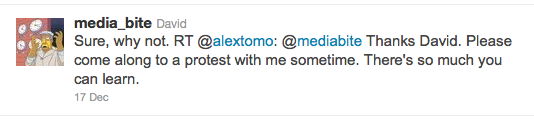
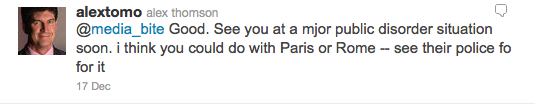
Protest: Journalist speak for ‘Major Public Disorder Situation’

Journalist Alex Thomson responded via twitter to our analysis of Channel 4’s live blogging of the recent protests against substantial university fee hikes, ‘‘Embedded’ with the police, Channel 4 and the UK student protests‘ (cross-posted at the Irish Left Review):

‘Embedded’ with the police, Channel 4 and the UK student protests

I thought it would be worthwhile drawing attention to a blog entry relating to the recent student protests in the UK by a senior journalist in a mainstream news outlet in order to highlight prevailing media attitudes towards protest and, in particular, civil disobedience. It’s important to make a distinction here, as the right to protest, while perhaps not the importance or effectiveness of it, is generally supported by the mainstream press. ‘Protest’ in this approved sense could be characterised quite simply as the congregation of a large group of people, meeting at a designated location, followed by a procession down a designated route, with a number of speeches at the end point and then quiet dispersal homeward. Anything that deviates from this formula is not typically welcomed in the press.

Civil disobedience on the other hand involves protesters not only voicing their opposition, opinions, etc, but voicing them in a manner they see fit (it is therefore unlikely to be collectively agreed), not that prescribed by or mediated with the coercive powers of the state. This type of protest is therefore much more likely to be dominated by police physical enforcement, as well as more indirect methods, such as intimidation, whereby, for example, photographs and video footage of protesters are recorded to discourage attendance.

Anyway, the blog entry in question was posted by Channel 4 News correspondent Alex Thomson, who, it appears, posted the entry live from the scene of the last major demonstration on Thursday last week (9/12/10). Thomson has been covering the ongoing protests for some weeks now and has been on the ground with protesters and police on more than one occasion.

In this report Thomson begins:

“My earlier predictions that today’s protest would absolutely lead to violence on a wider scale then we have seen have, it seems, been entirely borne out by events. We witnessed a police officer knocked to the ground and injured before the protest had moved a mile from London University early this afternoon.”

Thomson is clearly not talking about police violence when he says “today’s protest would absolutely lead to violence on a wider scale“. Despite what we know now about the level of violence perpetrated by the police, a fact that went mostly unreported and presumably unseen by reporters on the day of the protest. Thomson writes “We witnessed a police officer knocked to the ground and injured“, reaffirming, presumably, either that the media had broadcast images or had shown footage of a police officer knocked to the ground or that Thomson and his colleagues had seen the officer struck. Either way, he is attempting to draw an affinity with the reader and the victim of violence, seeking empathy for the injured policeman. At this stage, we might also presume at least one protester had been struck or injured, but Thomson chooses not to mention that possibility.

“From the outset the mood today was different. Radically different. There were scores turning up already masked up and the mood was louder, angrier, than before. There were hundreds here who were plainly out for a ruck with the police and they were going to have it wherever the police decided.”

Here Thomson evokes a picture of protesters as a wild, unpredictable gang moving in packs. Speaking very generally about all protesters, he says, the mood (which he reveals later in the piece he derived from what he overheard or saw, in fact there is no reference to actual interaction with protesters in any of his blog entries) was “[r]adically different” and protesters were “masked up” as opposed to wearing scarves etc. Thomson is adamant this indicated protesters were “plainly out for a ruck“. This use of language, masked up* and out for a ruck sounds slightly like that which might be used in gang discourse, with Thomson, in one sense, identifying the perceived source of the potential violence, and in another, identifying himself with an opposing side, the police. This closely chimes with the type of identification typical of correspondents embedded with the military in war zones.

These observations, paired with an earlier account that “speakers [had] invited protesters to “bring down the government” and ” bring this country to a halt”“, suggested only one thing to Thomson, the protesters were intent on violence. On the other hand, statements by the police prior to the march that they would implement kettling tactics etc were not, as far as he was concerned, deemed provocations.

“The place where the police stop the protest is the battleground for these things. Today many hundreds of marchers peeled off at various points along the route to Parliament Square. But when they entered the Square it was clear they were going no further at this stage.

That did it. Hundreds burst across police lines. The half dozen mounted officers simply fled from the Square to be reinforced much later. Barriers around the lawns of the Square itself were soon torn up and the crowds spilled across what is a traditional protest area for the British people. So they have certainly reclaimed that today, if nothing else.”

Here Thomson refers to an issue he revisited in a later post the next day, that of the location where students planned to stage the eventual demonstration at the end of the march, Parliament Square. An iconic location Thomson notes, “a traditional protest area for the British people“. The police did not want the “battleground” to be Parliament Square, but failed to direct the marchers towards the designated point. After reaching the rally point the protesters concerned themselves solely with “[tearing] up” barriers. This constant, and it could be reasonably argued unbalanced, focus on the ‘troublemakers’ within the protest is tempered only by fleeting, throw away, formulaic references in the closing paragraphs to what you might consider important contextual information – “most of those in Parliament Square and on this protest were peaceful“.

“From then on, hour after hour there was mass shoving at lines of riot police whilst anything that could be thrown at the police was thrown.

The police tactics are basically to stand there and take it, it seems. No water cannon or tear gas for these officers. True they had batons and used them when necessary with considerable gusto but in truth the police that I saw acted with a restraint you would not see in many other countries

It got worse. It got dark. There were a series of police mounted charges as it grew dark next to Westminster Abbey. Police came under a hail of paint bombs – but in truth the protesters were not particularly tooled up.”

Clearly there was was physical violence directed towards police during the protest, however it is virtually impossible to say with any certainty (although that doesn’t stop Thomson) whether this violence was a result of the violent nature of a section of the protesters, or whether this was a reaction to police tactics on this and previous marches, which, while designed to discourage future participation (e.g. kettling, or ‘detaining’ as Sky News preferred to refer to it) may have actually incited aggressive behaviour.

However, even accepting that there was violence on the part of protesters, most, if not all of it documented and transmitted incessantly on the 24 hour news channels (in contrast to those acts of violence committed by police, which are either not shown, or shown to much lesser degree), Thomson here frames that violence as entirely unprovoked and in turn shows complete ambivalence to the ‘response’ to that violence. He writes that police used “batons…with considerable gusto“, but only “when necessary“. Again, with reference to police cavalry charges, Thomson merely notes that they happened – “There were a series of police mounted charges” – without even commenting on the very real dangers of such actions. Clearly legimitising the use of force, and in fact, suggesting too little force was used: “The police tactics are basically to stand there and take it, it seems. No water cannon or tear gas for these officers.” While also presupposing police pacifism, declaring they simply just “[stood] there and [took] it“, before contradicting himself with the “gusto” “baton” observation. What Thomson could not have known at this time was that one student struck by a police baton would later fall unconscious and have to undergo brain surgery.

Thomson elaborates on every act that could potentially be deemed ‘violent’, he writes “It got worse…Police came under a hail of paint bombs“, painting (excuse the pun) what seems to be a unnecessarily exaggerated picture of the scene. Paint ‘bombs’ are hardly dangerous weapons, a ‘hail’ of which would be unlikely to do significant damage to vehicle or person. A point he is forced to concede in the next sentence: “in truth the protesters were not particularly tooled up.”

“Inevitably as afternoon turned to night there were injuries and currently the police say three of their officers are seriously injured and I saw several protesters with various kinds of head injuries – all of them dramatic and colourful, though I sense few were particularly serious.

There was fighting on at least three sides of Parliament Square and you can only witness one small part of a wider disturbance. It may well be that the numbers of people injured grow into the night where various bonfires have now been lit across Parliament Square.

It remains the case that most of those in Parliament Square and on this protest were peaceful. Some broke into a spontaneous and just a little bit ironic rendition of “Silent Night” as we filmed other protesters bash the police and get bashed in return over the crush barriers not ten feet away.”

In this last section, Thomson concedes again that his perception of the protest is only one possible vantage point, although the scene, he writes, was not one of ‘protest’ but of ‘disturbance’: “you can only witness one small part of a wider disturbance.” At this point the purpose of the protest, to object to what for many people will be an intolerable burden of debt in exchange for a third level education, has been entirely subjugated by Thomson’s narrative of barbarity.

The sense that Thomson has identified with the police is reinforced when it comes to detailing the injuries incurred during the protest. He writes “police say three of their officers are seriously injured“, where it could be inferred Thomson had sought information from the police on numbers injured or treated. At the same time, he refers only to seeing protesters injured, suggesting he made no attempt to find out how many were hurt or how seriously (ambulance and hospital services could have no doubt furnished him with this information if it was sought): “I saw several protesters with various kinds of head injuries“. But he not only shows a lack of interest in those injuries incurred by protesters, he actually seeks to undermine their severity and intimate that they were put-on or played-up: “[protester head injuries were] dramatic and colourful, though I sense few were particularly serious.” This seeming indifference is reiterated in a post later that evening when he writes: “Nine police injured – three seriously. And the protesters? Well, there will be scores of injuries.” Thomson relies heavily, it seems, on information supplied by the police: “at least 22 offences, mostly for violent disorder.”

Only in the closing paragraph does Thomson acknowledge, with some reluctance, “that most of those in Parliament Square and on this protest were peaceful.” A fact he repeatedly mentions in an earlier post, reinforcing it with the introductory phrase “But in truth…“, suggesting perhaps that he is conscious his focus on the violent element is inherently misleading. Or perhaps he is cognisant that what he witnessed, while mediated, he feels, faithfully by his reporting, tends to feed into and reinforce a general prevailing media discourse on the subject of student protest – one which values imagery of violence, predominantly against inanimate objects (such as the lone police van left within a kettle at an earlier protest). This preoccupation with violent imagery had Channel 4, at an earlier protest, soliciting photos of violence from protesters via social network mediums, under the guise of supporting ‘citizen journalism’.

The fact that Thomson is forced to admit “protesters were [for the most part] peaceful” stands in sharp contrast with the preceding nine paragraphs of the report, and it is these dominant sections that will no doubt define readers memory of the report and the protest itself. Thomson, by the way he has structured his report, must be entirely aware of this, and could only have set out to portray the protests, the protesters and the police in this manner. This must be infuriating for those protesters who, by many accounts, managed, by some fluke it would seem (or perhaps just the avoidance of media coverage), to witness no violence during their particular experience of the protest.

* John S, writing on the Media Lens Message Board, suggests the peculiar phrase ‘masked up’ is invoked to draw the allusion with ‘tooled up’

Revisiting media headlines on Wikileaked cables

In a previous post ‘Hidden Message in reporting of Wikileaked cables‘ we simply listed the reports published to date on the Wikileaked cables.

While the subject deserves far more attention than a WordCloud, I (we) haven’t had time lately to do anything more substantial. However, there are a few hints of potential bias that are apparent just by glancing at the headlines themselves.

For example, of the 43 articles (19 from the Irish Examiner, 10 from the Irish Independent and 14 from the Irish Times) :

1) 14 of them could be broadly described as condemnation (or the reporting of condemnation) of Wikileaks for making public the leaked cables

2) 5 of the articles focus on the potential or actual ’embarrassment’ brought by the cables on world leaders, personal and political

3) At least 5 articles focus on allegations of sexual crimes made against the Wikileaks founder in Sweden

4) Only 17 foreground the contents of the leaked cables, as opposed the political response / damage limitation arising from the leaked cables

Greatest threat to print journalism?

Answer: The Internet.

This is a theme that has popped up a million different times over the last number of years, “the death of print media” etc etc. According to the Irish Times Editor, Geraldine Kennedy:

the internet has posed a “huge threat” to the traditional structure and financing of the newspaper industry.”

While the internet is clearly drawing advertising and readers away from traditional print publications, there is no definitive evidence that the traditional media will die anytime soon. What we do know though is that the traditional media, in Ireland at any rate, is at this very minute under threat from a far more traditional source:

“THE IRISH Times Ltd made an after-tax loss of €27.9 million in 2009 as a result of costs related to a restructuring of the business and the effect of the recession on advertising revenues.”

“Circulation revenues fell marginally during the year but advertising income was 42.5 per cent lower due to the effects of the economic slowdown, particularly in property and recruitment.”

Maeve Donovan who “spearheaded the controversial “investment and diversification” strategy“, i.e. the purchase of MyHome.ie (which appeared to be a means of cutting out the middleman in the property advertising paradigm), also received “an ex-gratia payment of €1.1 million.”

Property advertising, as we all know, is declining predominantly because of an excess of 300,000 houses and the creation of a bad bank, guaranteed by the government and therefore the Irish public, with a balance sheet of empty and unfinished commercial property, which in turn prompted a series of deflationary government budget strategies, precipitating the IMF and ECB putting in place a means of exhorting billions of Euro from the Irish public to repay British, French and German banks for the coming generations.

So not only did the media’s symbiotic relationship with the property industry discredit journalism, and in turn alienate readers, but its over reliance on property advertising compromised the financial structure of instituion itself.

The traditional media doesn’t need a threat from the internet, it is well able to destroy itself.

“the slow return in confidence”

“Central Bank Governor Patrick Honohan said he believes the spread between Irish bonds and benchmark German bunds will ease from current “crisis” rates to the more sustainable levels seen in April of this year, if the Government’s fiscal policies are implemented.”

“”Much of the reason for the slow return in confidence [sic] lies in the parallel weakness of the fiscal situation,” he said.”[Irish Times, 10/11/10]

Where’s the evidence?