Category Archives: Bites

More on ‘bad journalism’

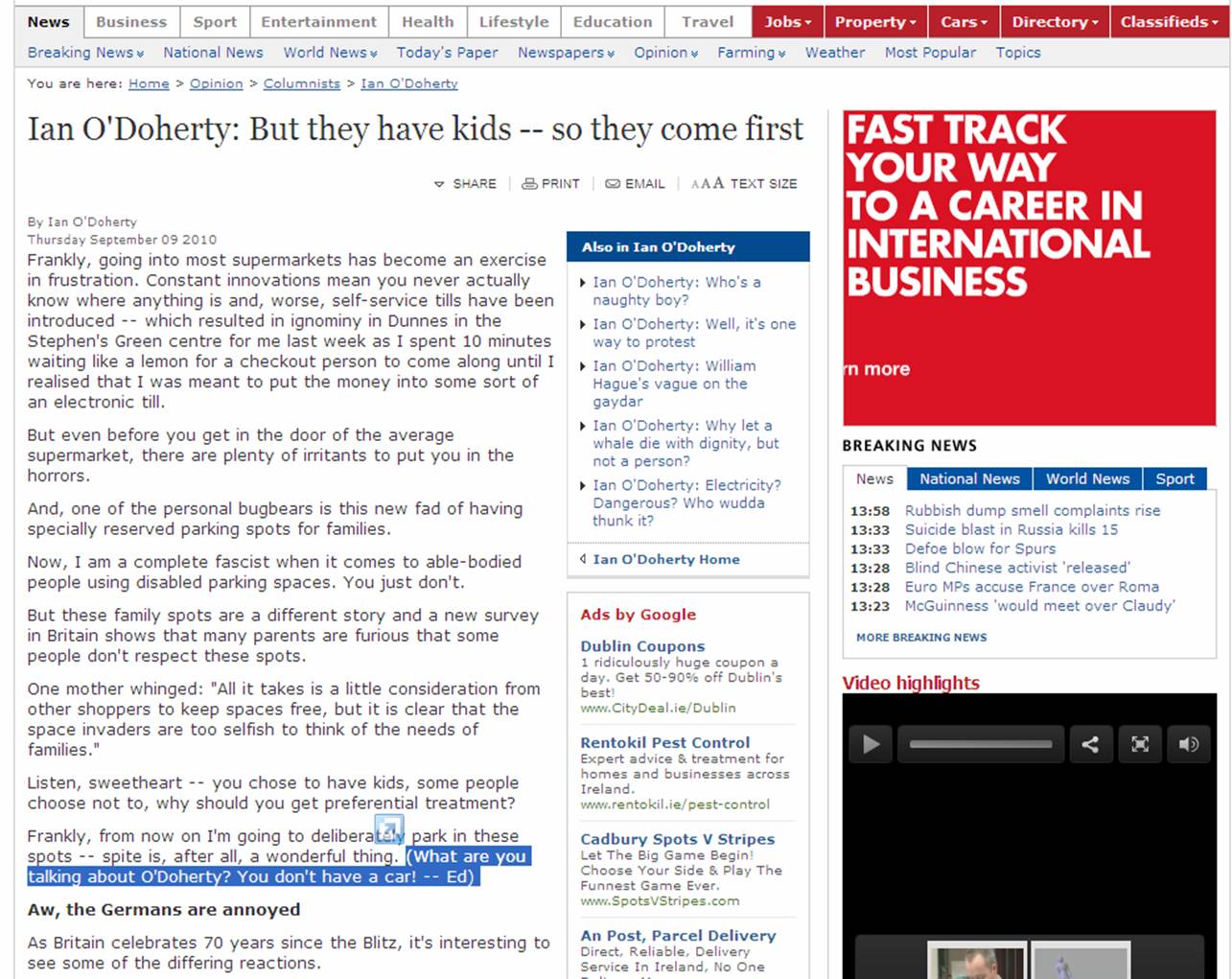
Last week we mentioned the Irish Independent’s Kevin Myers, this week we have the Irish Independent’s Ian O’Doherty:

The highlighted line reads:

(What are you talking about O’Doherty? You don’t have a car! — Ed)

Presumably written by a sub-editor and accidentally left in the published text.

[Update: As pointed out in the comments by Harry Browne, this is humour, not a mistake.]

For some reason the breaking news of O’Doherty’s first encounter with self-service supermarket checkouts and his irritation at wider car parking spaces for families reminds me of an article by Brenda Power in the Sunday Times back in May.

Power had, by glorious chance, happened upon a woman wearing a burka pushing a pram beneath a billboard displaying the famous Hunky Dory crisp advert, right in the midst of the controversy. This moment of pure chance prompted this article.

Also, O’Doherty claims in the article that most aid money sent to Pakistan is “being filtered away by corrupt politicians or the Taliban,” the clear implication being that to send money for relief work is to support corruption and terrorism. The truth is of course somewhat different. The Frontline Club recently hosted a discussion on the issue.

Karen Pierce, UK Foreign Office director for Afghanistan and South Asia, said that “In any event of this type there is a risk of diversion [of money] – I don’t think the risk in Pakistan is any greater in this crisis than in any other.”

“Conflict in the Middle East: Irish Media Bias?”

A discussion hosted by Leviathan Political Cabaret at the Mountains to Sea dlr Book Festival, featuring Robert Fisk, Richard Boyd Barrett and Vincent Lavery. The discussion will be chaired by Harry Browne.

Thursday, September 9th 2010

Royal Marine Hotel, Dun Laoghaire

End Times

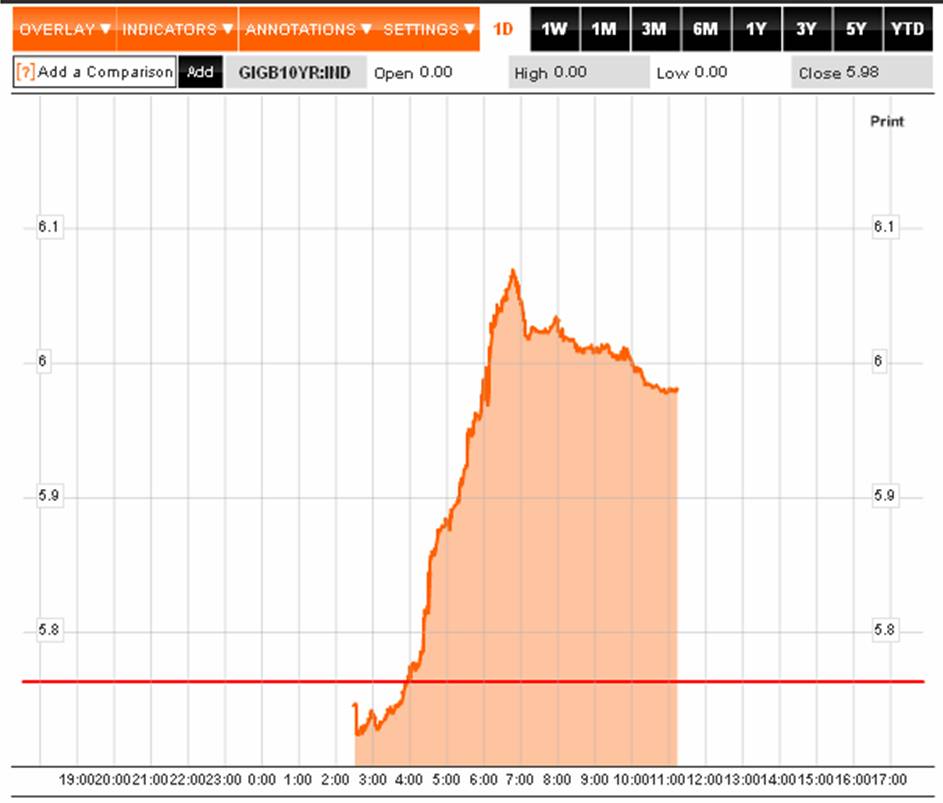
What happened today? What was all the noise about government bonds, spreads, cats in bins. This is what happened:

The graph shows the 10-year bond yield for Irish government bonds (essentially the cost of borrowing), which looks fairly dramatic, until you look at the same data over a longer time frame, in this case the last 3 years:

Data provided by Bloomberg.

Interview with Kate O’Sullivan…Arresting Tony Blair

via DublinOpinion via Workers Solidarity Movement

For more info…

War Criminal to come to Dublin

“He believed in peace. And peace came to pass.”

“As he giveth so shall he taketh away” Blair on life

I won’t get out of bed for anything less than a “real genocide”

I won’t get out of bed for anything less than a “real genocide”

Geraldine Kennedy: “The view of the newspaper is in the Editorials.”

The Irish Times Editorial on Tony Blair’s PR tour:

“Blair’s problem is that, little lies notwithstanding, in burnishing his claim in his book to a statesman’s legacy he can’t shake off the Big Iraq Lie that will in the medium-term colour all assessments of him. Some even want him arrested this weekend in Ireland as a war criminal but, whatever one’s views of the legality of the Iraq war, such posturing does nothing but deflect from the difficult pursuit of real perpetrators of genocide.” [Irish Times, 3/09/10]

Ethnic cleansing in Iraq, a Baghdad example:

Map via the Washington Post.

“As he giveth so shall he taketh away” Blair on life

[Updated]

This is a follow up to the post below.

Hi David,

calling war with Iraq a mistake and a flawed decision doesn’t absolve him from the consequences of his actions. That’s a leap too far. Your other points are fair enough. Except I do believe you can compare the North and Iraq: one was an achievement and the other was an atrocity. One doesn’t cancel out the other. I never suggested that. But you can’t look at his legacy and not take the North into account.

Best,

Martina

And our response:

Hi Martina,

Every person has their successes and failures, the fact Blair contributed to peace in the North and at the same time death in Iraq is simply a reflection of the power his position granted him. The reality is he had a vested interest in both.

Mistake, blunder, error, all imply mere bad judgment or ignorance, they put aside the deliberate and intentional nature of war. Blair is no fool, he digested and then disregarded the advice he was given, he “fixed the facts around the policy” to convince the public and he sent young British troops to kill and die.

The scale of suffering and devastation the US and UK have left in Iraq is incalculable. What emotional and physical scars will the “50,000 Iraqi refugees forced into prostitution in Syria” bring back to Iraq, if they ever return? In Fallujah a new study has revealed “a four-fold increase in all cancers and a 12-fold increase in childhood cancer in under-14s,” “exceeding those reported by survivors of Hiroshima and Nagasaki.” Imagine ten years from now trying to explain Shannon airport’s role to an Iraqi child that manages survives?

Blair will appear on the Late Late Show tonight, he will be welcomed and treated with deference by Tubridy. He will be praised for his work in the North, asked about the tough decisions and late nights. At some point Tubridy will become somber and perhaps ask whether he has any regrets about invading Iraq. Blair will say it was the right decision, and that while he regrets the lives of those killed (the lives the British government made no attempt to even count), he believes Iraq is better off. The interview will end on a lighter note and he will leave with a smile and a round of applause.

And the North really has very little to do with this. Whether Blair had contributed to peace there or not, he would still be welcomed by the media and establishment here, because evidently they really see very little wrong with killing and maiming the other side of the world.

Yours sincerely,

Another a reply:

You’re wrong on one point David, though right in many others. Blair’s contribution to the peace process is not simply a reflection of his position. He had the will to do it. if it was simply a case of position, any of his predecessors could have brought about peace. They didn’t. Of course he was helped by a readiness to negotiate and compromise within the IRA at that time. But it diminishes his role to say it’s just down to the fact he was PM. The Late Late will be exactly as you describe. That’s partly because this is how all interviews are carried out on chat shows – I don’t defend that either, it’s froth – and not because Blair is being singled out for an easy ride. But I like that you challenge me, and make me think harder. Thank you for that. Martina

“He believed in peace. And peace came to pass.”

Dear Martina,

I’ve just read your article and I wanted to make a few comments, if you’ll humour me.

You argue that Blair’s decision to invade Iraq was a “mistake” and a “flawed decision”, but he contends that it was the right thing to do. He says he “can’t regret the decision to go to war” only that he “never did guess the nightmare that unfolded.” On this point he has been entirely consistent since 2003. In 2006 he said in conversation with Michael Parkinson that he will be judged by God, not by man: “If you believe in God (the judgement) is made by God.” To call the invasion a mistake is to negate his right to free will and absolve him from the consequences of his actions.

When he writes in his memoirs that “the intelligence on Saddam and WMD turned out to be incorrect…how this came to be so remains a mystery” we can take it for granted that he is attempting to conceal the facts. We are both aware the British government made numerous (ultimately successful) attempts to “sex-up” the evidence for an active WMD programme – for the very reason that the information provided by the inspectors and the intelligence community did not justify an invasion, there was no “imminent threat” and the UN would not allow military action. The very body that was set up with “the goal of preserving peace among nations.” It’s no mystery why the evidence was incorrect, it was clearly fabricated.

Further still, during a meeting in January 2003 between Bush and Blair in the White House they both expressed “their doubts that any weapons of mass destruction would ever be found in Iraq.” They talked about ways to “provoke a confrontation,” one of which, was to “fly US aircraft, reconnaissance aircraft, over Iraq, falsely painted in United Nations colors.” The same memo confirms that Blair thought it “unlikely there would be internecine warfare between the different religious and ethnic groups.” But this is because he chose to ignore the best advice he received.

In November 2002 six of the UK’s top experts on Iraq and international security warned Blair that the consequences of an invasion could be catastrophic. He was told “the regime had embedded itself into Iraqi society, broken it down and totally transformed it. We would be going into a vacuum, where there were no allies to be found, except possibly for the Kurds.” In February 2003 the Joint Intelligence Committee warned again that the threat from Al Qaeda “would be heightened by military action against Iraq.”

Blair’s post hoc justification for the war centres on Saddam’s threat to Iraq’s people. Yet Saddam’s greatest crimes took place during periods of support from the US and UK, so they cannot be used as a justification for an invasion a decade later. During the preceding years of the invasion Saddam did continue killing people, a lot of people, maybe even hundreds each year. However, the invasion and occupation resulted in the deaths of hundreds of thousands (some studies estimate a million dead). Not to mention the fact the war created nearly 4 million refugees. Whether they regret it or not, Bush and Blair have killed more Iraqis than Saddam. That is a horrific legacy.

Imagine that, and then try and compare it to Blair’s contribution to the North.

Yours sincerely,

There’s bad journalism and then there’s bad journalism

There is a clear difference between ‘bad journalism’ and ‘bad journalism’.

The first type might be better described as lazy journalism, the kind of thing popular tweeter @badjournalism enjoys highlighting. It’s very entertaining, but it rarely tells us anything particularly interesting about why we read what we read in the newspapers. The second results from a convergence of a combination of ‘filters’. These filters are explained in detail by Herman and Chomsky in Manufacturing Consent: The Political Economy of the Mass Media; and some are discussed in our MediaShots and interviews.

Kevin Myers, writing in the Irish Independent, is like cupid to these two forms of bad journalism. Skilfully combining a prior judgement made on a particular issue that fits into a unique right wing anti-pro-whateversuits-authoritarian narrative that the Irish Independent readers allow themselves to be subjected to each day and a wilful use and misuse of facts or things he made up in order to bolster that fundamental.

In this particular article Myers has chosen the day when the countries most indebted bank recorded “one of the worst half year performances of any Irish company” (€8.2 bn for the first six months of the year) to lambast government and specifically Green Party governance on the basis of its public transport policy.

This case of alleged incompetence, there have been many of course, centres around plans to build a commuter rail line in the north of the city. He faults the plan on a number of points, but the two central ones are cost and environmental impact. The first is no surprise, capital expenditure is not very popular in the press at the moment, the second comes as a bit of shock, given it comes from a journalist who wrote of Global Warming:

“The biggest threat to mankind is probably less from “global warming” than from the hysterical myths about it which have besotted and beguiled the world’s scientific community.” [Kevin
Myers, Irish Independent, 06/01/10
]

But in reading a bit further it becomes clear that environmental impact is not so much a concern for our habitat as a tool with which to beat a designated enemy, and it is useful in this respect because of the contradiction it poses for the Green Party’s environmental credentials.

In order to back up this second point he writes:

“What’s really fascinating is that this proposal emanates from the Greens, because they are committed to public transport by rail as an ideological dogma. But this is not just any kind of rail: it runs underground, which means that a tunnel will be built to Dublin Airport, essentially parallel to the existing, and already under-utilised, port tunnel. Let’s use the Chesapeake Tunnel as a comparison. Its 23 miles required 100 million tonnes of concrete. The Necro North tunnel, however, will probably be one-third the length of the Chesapeake. Let’s be conservative, and call it a quarter.

That means 25 million tonnes of concrete, for the tunnel alone, and not including the stations (least of all the huge Dart-Luas underground interchange at the Green). Roughly 20pc of concrete is cement, which means around five million tonnes. But cement-manufacture is one the most CO2-intensive processes known to man. So, making five million tonnes of cement releases some four millions tonnes of carbon dioxide into the atmosphere.

But the whole country produced just 70 million tonnes of carbon dioxide in 2006 — levels already more than 25pc higher than the allowable emissions for the period 2008-2012, according to our submission to the UN climate change authorities. Yet instead of cutting emissions, we are proposing a scheme that will probably add 6pc to them through cement manufacture alone.” [Kevin
Myers, We don’t need BP to go prospecting in our waters to face ruin, Metro North will do it, Irish Independent, 01/09/10
]

The first question that came to my mind was whether the Chesapeake Tunnel is actually the real name of a tunnel or whether it was another humourless renaming of a tunnel, namely the Dublin Port Tunnel.

Well, as it happens there is a Chesapeake Tunnel. It’s full name is the Chesapeake Bay Bridge-Tunnel, built in 1964 and connecting “Virginia’s Eastern Shore with the Virginia mainland at Virginia Beach near Norfolk.” That’s Virginia in the United States by the way. And, as far as I can tell there isn’t another Chesapeake Tunnel anywhere else in the world. A strange choice of a comparison perhaps, but lets not get suspicious just yet.

“The Bridge-Tunnel measures 17.6 miles (28.4 km) and is considered the world’s largest bridge-tunnel complex. Construction of the span required undertaking a project of more than 12 miles of low-level trestle, two 1-mile tunnels, two bridges, almost 2 miles of causeway, four manmade islands and 5-1/2 miles of approach roads, totaling 23 miles.” [chesapeake bay bridge-tunnel, bridge-tunnel facts]

So the tunnel section of this particular piece of infrastructure is only two miles long. That poses a little bit of a problem. It is quite difficult to make a like for like comparison if the projects are entirely dissimilar. Now I don’t know where Myers’ figure for “100 million tonnes of concrete” came from, but it likely has a lot to do with the 5,189 concrete piles used to support the 20 km long bridge over water with a depth between 25-100 ft. But that’s entirely irrelevant, you just simply can’t compare a bridge with a tunnel.

On the other hand the Dublin Port Tunnel (DPT), you would have thought, is a more appropriate project to make the sort of comparison Myers is attempting.

According to Banagher Concrete Ltd, the company who produce the DPT’s precast segments (and confirmed by The Irish Concrete Federation):

“The lining consists of 3,037 rings with an internal diameter of 10.84m and a thickness of 350mm. Each ring is made up of six segments, weighing 8 tonnes each, and one key segment weighing 2.3 tonnes.”

So that’s 3,037 rings multiplied by six segments at 8 tonnes and one at 2.3 tonnes, which works out at 152,761 tonnes.

If I was a paid journalist and my articles were read by up to 560,000 people I’d probably go and check all these figures with the sources, but I’m not, so I won’t.

According to another report, a press release provided by DPT, the rings are about 1.7m wide, which seems about right. So that means 3,037 segments covers 5.16 km (the total length of the tunnel is about 9km, twin bore, but presumably the cut and cover sections are constructed differently, either way, it doesn’t matter the section weights are all that applies).

Now, the proposed Metro North includes approximately 10 km of tunnel, requiring 5,882 segments. Therefore based on the above figures, that works out at 295,864 tonnes.

Which is about 24,704,413 tonnes less than Myers’ estimate.

20% of this figure is 59,172 tonnes and if “making five million tonnes of cement releases some four millions tonnes of carbon dioxide into the atmosphere” then making 59,172 tonnes releases some 47,338 tonnes of carbon dioxide into the atmosphere.

Which, if you hadn’t guessed before reading it, makes the rest of the article complete and utter balderdash.

But what does this tell us about the Irish Independent? Very little we didn’t already know.
The smallest non-victory ever recorded

We recently had an almost infinitesimally short exchange with Michael Christie, Reuters Iraq Bureau Chief, where we challenged his figures for Iraqi mortality.

We are happy to say Christie has since attempted to redress this:

“Muhsin al-Timimi, a 47-year-old journalist, hopes for an end to the war in which more than 100,000 Iraqi civilians, and more than 4,400 U.S. soldiers, have died.” [Iraqis say war “not ending” despite U.S. drawdown, 29/08/2010]

Of course, still no mention of The Human Cost of the War in Iraq, A Mortality Study, 2002-2006.

War Criminal to come to Dublin

Tony Blair will be at Eason on O’Connell Street on 4th September 2010.

For your information:

Prosecuting a crime against peace (otherwise known as a crime of aggression) depends on one of two factors… www.ArrestBlair.org

The Human Cost of the War in Iraq, A Mortality Study, 2002-2006