ESRI – Thought-provoking or depressing?

There’s another ESRI report out today. Below are two takes on it, one from a Nobel Prize winner in Economics and the other from the Editor of a newspaper that has an expensive sideline in property advertising and has championed fiscal consolidation since the ‘downturn’:

“In a thought-provoking excercise, published today, the ESRI sketches both a “high growth” rebound and a more plodding “low growth” pace of recovery.

Stronger international demand for Irish-made goods and services will act as an engine of growth, hauling the economy back to sustainable prosperity.

But the positive effect on the overall economic outlook of its upward revision for exports is more than offset by its more downbeat analysis of the costs of the banking crisis. These are far greater than it believed just 14 months ago.

[T]he ESRI concludes that even in its best- case scenario, the Government will need to introduce further budgetary consolidation measures, on top of those to which it has already committed, if it is to bring its budget deficit below 3 per cent of GDP by 2014, as it has targeted.

At a time when kites of many kinds are being launched in anticipation of the forthcoming budget, the ESRI flies its own. It suggests that there may be real benefits, in the short term and long, of a more front-loaded fiscal adjustment.

Specifically, the report’s lead author, Prof John FitzGerald, calls for the Government to consider a reduction in the deficit next year of €4 billion, rather than the planned €3 billion. This additional pain could yield gains in terms of lower debt servicing costs and higher investment. The Cabinet will begin its consideration of all these matters today.” [The Irish Times, July 21, 2010]

“There’s a new report out from Ireland’s Economic and Social Research Institute (pdf) calling for even more austerity, arguing that this will lead to faster economic growth. And the report looks authoritative: it’s full of charts and tables, and frequently refers to an underlying quantitative model.

What the careless reader might miss, however, is the fact that the policy conclusions are not, in fact, derived from the analysis — they come out of thin air. The authors simply assert that more austerity now would lead to a lower risk premium and hence higher growth, based on no evidence I can see. They don’t even offer any quantitative assessment of the extent to which more austerity while the economy is still depressed would reduce future debt burdens. In short, it’s a pure appeal to the confidence fairy.

One more thing: a key element in the ESRI analysis is the assumption that the financial crisis has permanently lowered Ireland’s growth track. That may be so — but if it is, a large part of the reason is the effect of a prolonged slump on investment and structural unemployment (the long-term unemployed tend to stay that way even after recovery). Now, some of us would argue that these effects suggest that government should do all they can to avoid prolonging the slump even further, that austerity may be self-defeating. But such concerns don’t even get mentioned.” [The New York Times, July 21, 2010]

US war on Afghanistan – “A more realistic perspective”

An Editorial in today’s Irish Times brings readers bang up-to-date on the US war on Afghanistan.

We are told “NATO…are quietly scaling down their commitment to it ahead of withdrawing troops,” while the US and UK are still willing to give military means one last chance before the inevitable “political negotiation with the Taliban.” As the costs continue to rise, their critics are not so confident, saying “it is time to scale down ambitions there and to reduce and redirect the military effort.”

Afghans are in agreement, they “do not want Nato there and support efforts to reach a political deal with the Taliban, based on the assumption that it is not a unified resistance run by al-Qaeda, but a coalition of regional and local opponents who could be attracted to an alternative path.”

An ‘assumption’ supported by at least onewestern official” in Afghanistan, who said in 2006:

“The name “Taliban” may be misleading, he explained – as certainly is the assumption that its insurgency is a simple black and white struggle of foreigners versus fundamentalists. “This is about narcotics, corruption, tribal tensions, warlordism, illegal armed groups, Arabs, Iranians, Chechens – and all of these factors are interrelated. You never know who you are dealing with. You probably have some guys working for good and bad at the same time.” [July 4, 2006]

The US legacy to Afghanistan is summarised as follows: “rampant insecurity, endemic corruption, widespread poverty and weak government.” Along with the possibility of “a new civil war” potentially resulting in “an effective partition between the north and south of the country, which could make parts of it even more of a haven for international terrorism.”

This analysis is interesting in several respects, the most obvious of which being that the story is told entirely from the perspective of those in Washington and London. According to the Times there are only two sides to the war: the proponents in the White House and Downing Street and the critics in the White House and Downing Street.

Long gone are the days when anti-war activists (the vast majority of the world, including Afghans) had a say in the matter, even if the reasons for their objections became entirely bastardized when squeezed through the journalistic editing process practiced at the Times: “They were never going to be convinced it could work, or convince a country that believes it has a right to strike back.” [October 10, 2001]
Another useful omission is the purpose of the whole bloody venture. The purpose of the war, which has gone through countless improbable iterations, now seems to be the idea of a courageous defeat, following Obama’s unfulfilled lofty ambitions of “reveres[ing] the recent impression of slow defeat or stalemate.” But lest we forget the original motive, finding and killing Osama bin Laden:

“The United States-led military riposte so intensively under preparation since the terrorist attacks on New York and Washington on September 11th is now under way. A formidable force has been assembled to attack bases in Afghanistan used by the al-Qaeda organisation and its leader, Osama bin Laden, and the political and military infrastructure supporting them.” [October
08, 2001
]

“Nearly three weeks on from the beginning of the US-led military campaign against Afghanistan it is clear that its objectives are increasingly difficult to attain. There is little sign that the Taliban regime is close to collapse. It is proving difficult indeed to assemble an Afghan coalition that might replace it. The search for Osama bin Laden and his al-Queda organisation, blamed by the United States for the atrocities in New York and Washington on September 11th, has so far proved fruitless.” [October 26, 2001]

“It should be remembered that even if a major transition is successfully engineered in Afghanistan as a result of these events the objective of bringing the perpetrators of the attacks on New York and Washington to justice remain to be achieved. The chief suspects, Osama bin Laden and his al-Qaeda organisation, are still at large.” [November
14, 2001
]

The “military victory” of this “this short war” “demonstrates the awesome effectiveness of modern US air power accurately deployed.” “It will allow the US-led campaign in pursuit of Osama bin Laden and his al-Qaeda organisation to go ahead unhindered and maybe successfully.” [December 7, 2001]

“The 18,000 US troops still deployed have failed to find Osama bin Laden despite inflicting huge casualties on his supporters.” [November 21, 2006]

No Weapons of Mass Destruction and no dead bogeyman. That’s 0 for 2 for the US military, unless that is, they had an ulterior motive?

[Image via Wikicommons “Pullout of Soviet troops from Afghanistan. 1988. Photo by Mikhail Evstafiev.”]

I’ll eat my hat if the Irish Times publishes this

Madam

Given the significance of the Corrib gas project to the Irish economy and the highly controversial nature of the way it has been carried out so far it beggars belief that severe criticism of the project from no less a person than a former Norwegian oil company board member does not get front page billing in The Irish Times.  On the 12th of July another of Lorna Siggins’ scrupulously accurate pieces about Corrib was once again buried in the paper despite the importance of its content.

Could your muted coverage be explained by Managing Editor, Peter Murtagh’s documented hostility towards the local people who oppose the project for all the reasons identified by Mr Stein Bredal?  When an experienced oilman observes that just about everything is wrong with the project – from the location of the pipeline and refinery to the terms on which the deal was done this is big news indeed.  Mr Bredal also refers to the tried and trusted tactic of oil and gas companies who set out to manipulate the media to act against local communities by accusing them of being ‘crazies and fundamentalists’.  This is exactly what has happened in much of the Irish media in relation to Corrib, with Mr Murtagh being among those most willing to lead the charge against people under enormous stress, including many incidences of physical assault and, according to Pat O’ Donnell, the threatened use of guns.  Two men are now scandalously in jail on dubious charges for opposing the Corrib project on entirely legitimate grounds – both of them caricatured by the media exactly as Mr Bredal describes.

Of course Peter Murtagh is by no means alone.  Pat Kenny for RTE, for example, has marked him every inch of the way in helping to promote a mountain of widespread media inaccuracies about the protest such as claiming that the pipe in Mayo is no different to the domestic pipes that are under the streets of Dublin.   In fact the pipeline in Mayo would be running at up to five times the pressure and will contain volatile, untreated gas close to some people’s homes – allowing them just 30 seconds of life in the event of a rupture.  I wonder what the story would be if the pipeline and refinery were located outside their own front doors or in whatever no doubt leafy suburb or satellite of Dublin they live in? Is there any siginificance in the fact that Shell Oil’s most senior PR representative in Ireland, Mr John Egan, was previously an RTE reporter, well known to his former colleagues and friends in the small world that is the Irish media?

The IMF have just ordered Brian Lenihan to discover another E3.5bn from the wages of Irish people but still no editorial from the Editor of Ireland’s paper of record calling for a root and branch reappraisal of our disgraceful oil and gas licensing terms though we so desperately need it.  Meanwhile, Mr Connor Lenihan has confidently announced that there could not be a BP/Gulf of Mexico type of disaster in Irish waters.  If ever The Fates were tempted, they surely were by that.

And I will eat my hat if this letter is actually published.
Yours sincerely
Miriam Cotton
Editor
MediaBite

“What was built to keep people safe, is gonna trap them inside”

A personal story from the solitary residents of one of Northern Ireland’s ghost estates:

via the pin.

The third installment of Eamonn Crudden’s series of short films ‘Roscommon Death Trip’ is out now and can be found here.

The BBC’s random complaint response generator

Below is the response from the BBC Complaints department to this email, sent over a month ago.

Thank you for contacting us about ‘Freedom Flotilla’.I understand you felt the coverage of the Israeli armed forces attack on the Gaza ‘Freedom Flotilla’ was bias against Israel. I have added your views to our audience log. This is the internal report of audience reaction which we compile daily and which is circulated to all programme makers, commissioning executives and senior management. Your points, with other comments we received, are therefore circulated and considered across the BBC.

The BBC places very high importance on achieving impartiality in its coverage of the Middle East and all other issues and strongly rejects allegations of bias for or against either Israel or the Palestinians.

From its Middle East Bureau in West Jerusalem, the BBC is well placed to report the Israeli point of view and the office is visited frequently by senior Israeli officials appearing on-air. Israeli Government spokesman Mark Regev makes regular appearances and has done so during these events too. Other interviewees include such prominent Israelis as Israeli cabinet minister Benny Begin, Deputy Foreign Minister Danny Ayalon, David Horowitz of the Jerusalem Post and Gerald Steinberg of the Israeli organisation NGO Monitor.

We have of course also had frequent contributions from our correspondent Wyre Davies who was gathering information inside Israel. We also carried the press conference given by Prime Minister Benjamin Netanyahu. In addition, our Middle East editor Jeremy Bowen has reported from both Jerusalem and Gaza throughout these events. We are scrupulous at all times to try to ensure our coverage remains fair and balanced.

I do understand you feel strongly about this, so let me reassure you that I have added your views to our audience log mentioned above. We appreciate all viewers comments as this helps us in future decision making when producing programmes.

Thank you once again for taking the time to contact us.

Kind Regards
BBC Audience Services

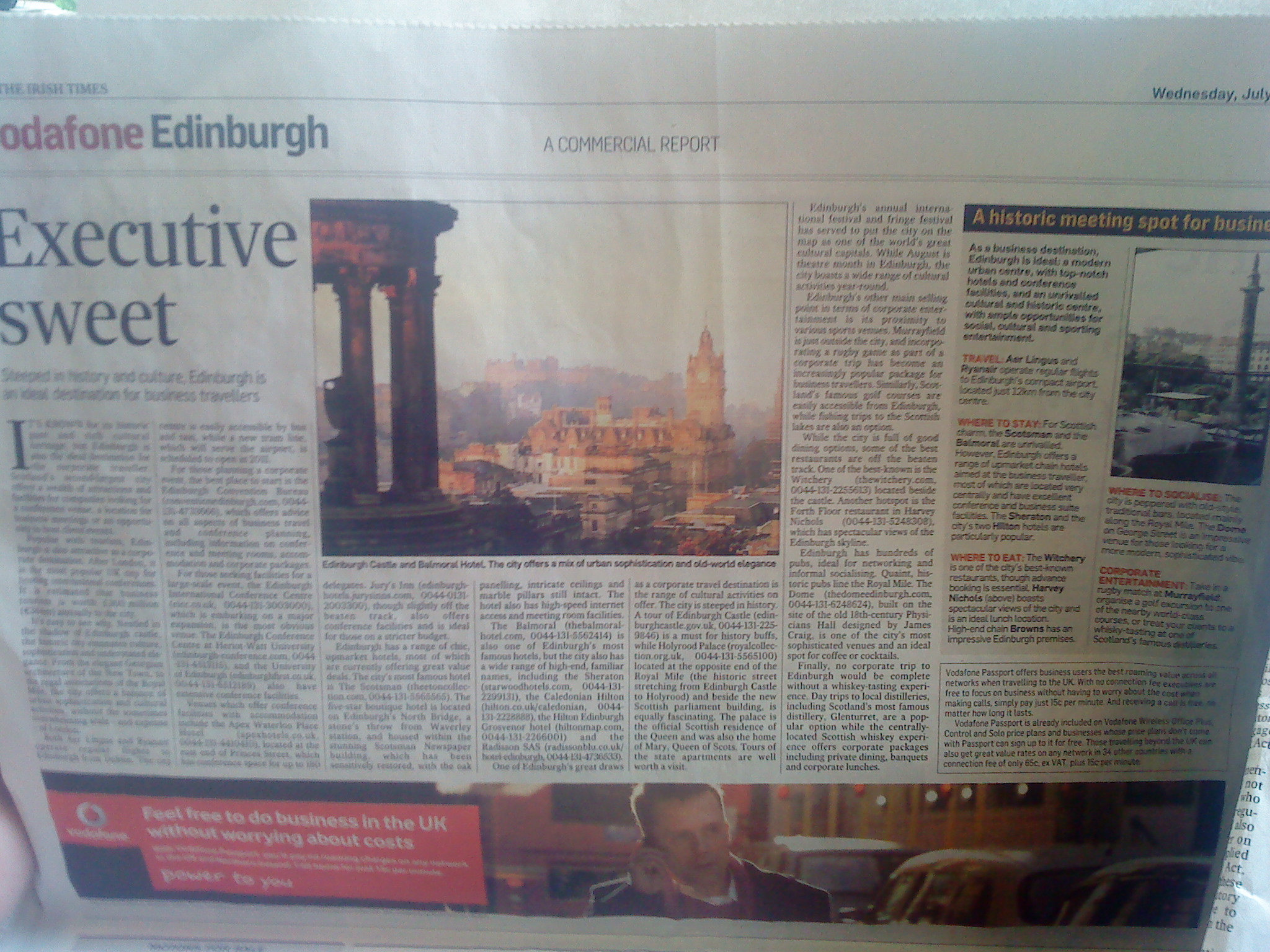
News or advertising?

Flicking through a copy of the Irish Times someone had discarded in a cafe the other day I came across this half page spread. At first glance it appeared to be ‘news’, but without a name to go with the article and the words ‘Commercial Report’ emblazoned above in tiny writing, it seems the article is actually an advertisement. I thought this kind of thing was only done in the Metro Herald.

‘Officials say’, ‘officials say’, ‘officials say’, ‘according to an official’

Below is an exchange with a senior journalist from the Irish Times, who takes issue with our latest MediaShot ‘The false reality of news journalism’ – Reporting Palestine and the Mavi Marmara.

David:

I did not manage to get beyond the second paragraph of this because of your self-serving selective quote from the report to which you refer. You say below: “An Israeli naval patrol killed at least four Palestinians…on their way to carry out a terror attack.”

But the Reuter report, as published on our breaking news service, said: “An Israeli naval patrol spotted a boat with four men in diving suits on their way to carry out a terror attack and fired at them,” an Israeli army spokesman said, adding that the patrol had confirmed hitting its targets (emphasis added).

We therefore anchored the claim of motivation firmly where it belongs – with an Israeli army spokesman. It is the duty of the media to report assertions of both sides, as we did in this case.

If you are going to throw stones, you’d need to do rather better than this.

[Name withheld]

I responded:

[Name withheld],

That’s exactly the point made in the piece. As Fisk says further on in the piece: ‘officials say’, ‘officials say’, ‘officials say’, ‘according to an official’.

With regards the opening reference, clearly we’re reading different reports. The report leads with a two paragraph justification from the Israeli military. It is followed by a statement from Hamas officials confirming the deaths. The report then mentions the flotilla attack, before adding a short tit for tat and then concluding with the journalists own commentary, corroborating the Israeli official’s ‘claim of motivation’: “Palestinian militants in Gaza frequently try to attack Israeli border patrols and sporadically fire rockets and mortar bombs at Israel. In February, Palestinian militant groups in Gaza sent explosive devices, thought to be primitive sea mines, out to sea intending to hit naval vessels. At least three devices washed up on Israeli beaches and were detonated by sappers.”

I can’t imagine a situation where if Hamas’ military wing conducted assaults in Israeli territory killing a number of Israelis (military or otherwise) the Irish Times would publish reports leading with ‘claims of motivation’ from Hamas officials, followed by a short sentence from Israel confirming the deaths, followed again by a couple of paragraphs about, for instance, the number of attacks launched by Israel over the last couple of years or maybe reference to the number of Palestinians killed during ‘Operation Cast Lead’.

In the same way I couldn’t imagine a situation where if the Turkish military killed 9 Israelis the Irish Times would publish an opinion article by the Turkish ambassador 7 days before they published one from the Israeli ambassador.

Here’s another few examples. I’ve just plugged the words ‘palestinian’ ‘attack’ ‘israel’ into the Irish Times archive.

5 Palestinian “militants” killed by Israeli troops. Only Israeli viewpoint sought.

5 Palestinian “militants” killed by Israeli troops. Confirmation of the deaths by both Israeli and Hamas officials. Context for the killing provided by Israeli official only: “Before the Israeli air strike took place, militants fired two rockets from coastal Gaza, both striking near the city of Ashkelon and causing no casualties, a military spokesman said.”

1 Palestinian “gunman” killed by Israeli troops. Israeli statement sought only. Context provided as follows: “Hamas has been urging smaller militant groups to refrain from launching attacks against Israel, which carried out a devastating military offensive in the Gaza Strip 17 months ago with the aim of halting cross-border rocket fire. Israeli air strikes targeted tunnels in the northern and southern Gaza Strip this morning after Palestinian militants fired two rockets that landed in fields inside Israel. The Israeli army says that some 350 rockets have been fired from the Gaza Strip since Israel ended its military offensive there in January 2009. More than 3,000 rockets and mortar rounds were fired at Israel from the Gaza Strip in 2008.”

1 Palestinian “militant” killed by Israeli troops. Israeli officials dominate report. Palestinian officials relegated to closing lines.

1 Palestinian “militant” killed by Israeli troops. Only Israeli viewpoint sought. Palestinian statement used to confirm deaths only.

1 Palestinian “militant” killed by Israeli troops. Only Israeli viewpoint sought. Palestinian statement used to confirm deaths only.

1 Palestinian “militant” killed by Israeli troops. Only Israeli viewpoint sought. Palestinian statement used to confirm deaths only.

2 Palestinian “militants” killed by Israeli troops. Only Israeli viewpoint sought. Palestinian statement used to confirm deaths only.

3 Palestinians killed by Israeli military. Israeli statement comes first, followed by Palestinian statement. The Palestinian statement is broken by commentary: “Palestinian medical workers said three workers in the tunnel, part of a system used mostly to smuggle goods and weapons into the Gaza Strip, were killed and six wounded when the tunnel collapsed in the attack.”

No one is throwing stones. The Times’ record speaks for itself.

Best wishes,

David

‘The false reality of news journalism’

Reporting Palestine and the Mavi Marmara

One of the most interesting features of mainstream reporting on Israel and Palestine is the disparity between the way violent attacks by each side are presented. Israel’s actions are chiefly explained in terms of its right to “self defence“, while those carried out by Palestinians are more often than not portrayed as attempts to undermine Israel’s “security“.

Palestinian attacks on Israeli targets are depicted as random acts of violence, with no mitigating or explanatory considerations whereas Israeli attacks are predominantly reported as responses to a Palestinian threat. For instance, a recent Irish Times report on the killing of four apparently unarmed Palestinians by the Israeli Defence Forces (IDF) offered the following by way of explanation: “Palestinian militants in Gaza frequently try to attack Israeli border patrols and sporadically fire rockets and mortar bombs at Israel.” In the same report Israeli actions were described as follows: “An Israeli naval patrol killed at least four Palestinians…on their way to carry out a terror attack.” This narrative presents Israeli aggression, the killing of unarmed persons in foreign waters, as a necessary response to Palestinian terrorism. In effect, it serves to ligitimise that aggression.

One possible explanation for this imbalance can be found in the very words journalists chose to use. Journalist Robert Fisk claims that “journalists have become prisoners of the language of power.” Addressing the Al Jazeera Annual Conference in May this year, he said:

“We are drowning our vocabulary with the language of generals and presidents, from the so-called elites, from the arrogance of the Brookings Institute experts, or those of those of the Rand Corporation or what I call the ‘TINK THANKS’. Thus we have become part of this language…And when we use these words, we become one with the power and the elites which rule our world without fear of challenge from the media.”

On the 8th June Fisk appeared at the Dalkey Book Festival in conversation with Vincent Browne, where I asked him:

“Why do you think journalists relinquish control of language to the institutions of propaganda so easily? For example, following the flotilla attack, journalists responded by adopting Israeli government language, so when the activists were freed, it was reported they were ‘deported’. In the same way Israel always ‘detain’, whereas Palestine always ‘kidnap’.”

Fisk responded:

“Journalists now use the words that are provided for them by power. For example, journalists use the term ‘spike’ in violence and there’s a reason for that, Americans like to see the word, because a ‘spike’ goes up and then a ‘spike’ goes down. If you were to refer to an ‘increase’ in violence, there’s no guarantee that it will go down. In the same way a ‘surge’ suggests a tsunami, or a massive natural force. In real terms this ‘surge’ is a reinforcement and you need reinforcements when you are losing a war. Similarly a ‘wall’ becomes a ‘fence’, a ‘settlement’ becomes a ‘colony’, which becomes a ‘neighbourhood’ or an ‘outpost’.

Again and again journalists use the words of power in this way – ‘officials say’, ‘officials say’, ‘officials say’, ‘according to an official’. In effect we are now using the words of the Defence Department, Downing Street and so on. I think the reason for this is because it is easy, it is less likely to invite criticism. But the problem is that in using these words we desemanticise the war, because, while I disagree with all violence, if you see a Palestinian throw a stone and you know it is because there is a ‘wall’ being built around his house, you can begin to understand. But if that dispute is about a ‘fence’, you might be led to believe all Palestinians are generically violent.”

On the 31st May an event occurred in international waters off the coast of the Palestinian territory of Gaza which has highlighted the pervasive influence of the “language of power.” A flotilla of vessels, manned by hundreds of activists and carrying tonnes of humanitarian aid, was intercepted and boarded by the Israeli navy. On the Turkish ship the Mavi Marmara nine activists were killed, most of them shot repeatedly at close range. Scores of others were injured, including several Israeli soldiers.

The media news storm that followed the event can be defined by three characteristics: 1) The Israeli government version of events dominated coverage 2) Where the testimony of activists was reported it was generally in the context of denying Israeli allegations 3) Israel was presented as acting in self defence, whether as a state enforcing a blockade, or as individual soldiers protecting themselves; those aboard the flotilla were for the most part presented as instigators of the violence. The reason there was a media storm at all, unlike the killing of the Palestinians described above, is that this incident involved the kind of “bloodshed that would spark an international outcry” or to put it bluntly, Israel had killed non-Arabs.

At approximately 4:30 am on the 31st May the communications systems aboard the vessels were blocked by the Israeli Navy, cutting off all contact with the outside world. Israeli commandos then stormed the ships in an operation conducted by hundreds of soldiers using an array of combat craft, including “four Frigates, three Helicopters, two Submarines and twenty Zodiac boats.” Once the crew and passengers had been subdued, the vessels were commandeered and “escorted” by force to the Israeli port of Ashdod. Here activists were stripped of all cameras, computers, telephones and recording equipment and “detained” against their will, only to be “deported” several days later on the condition they sign forms declaring they had entered Israel illegally. In contrast to the capture of British soldiers by the Iranian military in 2007 few commentators dared to submit that the activists had effectively been “kidnapped.” Where the term was used it was primarily in response to comments made by government officials, in this case Ireland’s Minister for Foreign Affairs.

The flotilla was just the latest in a series of aid convoys that have attempted to break the “blockade” of Gaza – an escalation of those restrictions imposed in 2006 in response to Hamas’ victory in elections deemed free and fair by the international community. According to the Israeli government the blockade is “an exercise of the right of economic warfare” “intended to achieve a political goal,” namely to undermine support for and ultimately oust Hamas. According to Gideon Levy, columinst for Haaretz *, Dov Weissglas advisor to the Israeli Prime Minister joked that the blockade was like “an appointment with a dietician. The Palestinians will get a lot thinner, but won’t die.” It could however more accurately be described as a “siege” (a term seldom used), as Israel maintains almost total control of both Palestinian borders and airspace, it also makes regular military ‘incursions‘ into the territories, while continuing a process of colonisation that results in ever expanding Israeli borders and a corresponding shrinking of Palestinian borders. The United Nations has called for Israel to lift the “siege” and has described it variously as “collective punishment“, a “crime against humanity” and a “war crime.” Ironically, a recent opinion piece in the Irish Times described how Israelis live under a “suffocating siege mentality” as a result of their “self-inflicted isolation.” The same piece makes reference to the “checkpoints” Israel enforces around Palestine, ensuring near absolute control of their “only exit.”

As with the navy patrol incident described above, the “blockade” is almost always portrayed as a response to Palestinian violence. The Irish Times claimed in a report last week that the blockade has been “in place since Hamas seized power in the strip three years ago,” another claimed it is “designed to stop arms and “dual-use” equipment reaching Hamas and other militant groups.” More recent reports erroneously claim it was “first introduced in June 2006 when [Israel’s] soldier Gilad Shalit was captured.” In all cases Israel is presented as reacting to a violent incident, as opposed punishing Palestinians for voting for the ‘wrong party’ in democratic elections. The idea that the blockade is actually a security measure is contradicted by the terms of the blockade itself, such as details of the banned goods, most of which would prove entirely useless when used as weapons: “items such as school supplies, books, computers, kitchen utensils, mattresses and toys.”

The events that took place during the attack on the Mavi Marmara are still disputed and will likely remain unclear in the absence of an independent investigation. This uncertainty has prompted some journalists to euphemistically describe them as “clashes“, suggesting a shared premeditation and thus an equal apportioning of blame. Details of the casualties aboard the ship do not however support this – injuries were ‘disproportionately’ sustained by passengers. Autopsy results revealed “nine Turkish men…were shot a total of 30 times and five were killed by gunshot wounds to the head. The results revealed that a 60-year-old man, Ibrahim Bilgen, was shot four times in the temple, chest, hip and back. A 19-year-old, named as Fulkan Dogan, who also has US citizenship, was shot five times from less that 45cm, in the face, in the back of the head, twice in the leg and once in the back. Two other men were shot four times, and five of the victims were shot either in the back of the head or in the back.” While the Israeli government claims one soldier sustained gunshot wounds, the navy recorded no fatalities.

In the hours and days following the assault Israeli spokespersons dominated the media narrative. Access to the passengers was restricted, preventing any alternative narrative from emerging. The IDF and the Israeli Government’s Ministry of Foreign Affairs drip fed statements and selectively edited video and audio footage (less than 4 minutes of video footage has been released). This policy of providing video footage has had the effect of devaluing the authority of eye witness testimony, whilst also satisfying the media appetite for immediate, easily digested information, preferably with an authoritative stamp. At the same time footage taken by passengers remained under Israeli lock and key, with only those recordings concealed and eventually smuggled out made public. In contrast to the IDF videos this footage has not been publicised prominently.

Israeli officials made repeated allegations that the navy were “set upon” in a “planned” and “premeditated” “ambush“. Readers were told the navy had encountered “unexpected resistance” and that the soldiers had simply acted in “self-defence.” This in turn led to discussion of whether the violence was “disproportionate” or “legal“, not whether the use of violence was justified at all. Further claims alleged passengers were “allies” or had “links” to “terrorist organisations” including “al-Qaeda,” or were just “sympathetic” towards them. Other reports simply implied the connection: “the main umbrella group…preach non-violent resistance…[however] many [are] linked to Islamic organisations.” These claims were repeatedly reported without any further examination. A number of opinion articles did expand on the allegations, with one writer referring to them as “government propaganda,” however they were reluctant to dismiss them entirely and so made vaguely incriminating suggestions that while “the vast majority of those involved did not have any violent intentions,” the “well-meaning people” had been “used as tools by those with ulterior motives.”

Eyewitness accounts which appeared four days after the assault told an entirely different story: “Patel claimed that as soon as the Israeli Defence Force helicopter appeared above the Mavi Marmara, “it started using immediately live ammunition” without any warning being issued. Harrison, 32, from Islington, north London, also witnessed the Mavi Marmara being stormed from above by helicopter and said the Israelis started firing before their troops touched down on the boat.” Yet articles suggesting the ships passengers had acted in self defence were in the minority.

Much was made of the fact the passengers were “armed“, with reports describing passengers as “pipe and knife wielding pro-Palestinian activists,” a “knife-wielding mob” and “protesters wielding knives and clubs.” The array of “weapons” including “knives, metal rods, chains, broken bottles” can no doubt be found aboard any boat, but was still considered of major importance. Other more extravagant accounts stated “two pistols had been found on the Turkish ship” and that the navy “were shot at.” Later reports explained that “activists had fired guns they had seized” from the armed soldiers. Activists were therefore continually forced to deny in the first instance that they were armed and then to prove their peaceful intentions. The guns, we were eventually told, had indeed been taken from the soldiers, they were then thrown overboard or ‘made safe’.

The weapons carried by the navy commandos were also the subject of reporting, but from a very different perspective. Where the activists’ metal rods and table legs were discussed solely in terms of their potential to cause harm, the Israeli weapons were discussed in terms of their use in “riot-control“. Commandos were armed with “non-lethal” “stun guns” and “paint ball guns in place of their usual rifles.” Admittedly, they also carried handguns or pistols, but it was stressed the soldiers were “under strict orders to only use them in life-threatening situations.”

In light of the deaths and the specific details of the injuries suffered Israel was forced to admit that the “marines [had] opened fire.” However, the life threatening situation they were allegedly responding to changed from paragraph to paragraph. In one sentence the soldiers claimed that “they came under fire before shooting back.” In the next “they opened fire in response to a “lynch”.” Despite the absence of video evidence reports repeated the claims, providing some intuitively implausible sentences: “activists…tried to lynch the heavily armed naval commandos who stormed the ship.” But on the basis of these unsubstantiated claims some commentators justified the use of “lethal force” saying the navy had been “goad[ed] into excessive action“, and minimised the consequences of it as “heavyhanded” or “excessive“. While Israel’s actions “may be inexcusable, they are explicable.”

Just one day after the raid, an opinion writer in the Irish Times deemed the action: “excessive force to prevent a humanitarian aid convoy.” Which raises the improbable question, is there an acceptable amount of military force to prevent a humanitarian aid convoy? This type of discourse has had the effect of reducing a “violent” and “bloody” encounter to a “botched” raid, full of “errors and misjudgments” and “wrong-headed decisions.” Few journalists chose to dispel the tenuous mitigating circumstances conjured by the IDF and simply state: “What happened…was not an accident. It was a crime.”

Whether articles were condemning the assault or supporting it, opinion writers and editors were virtually unanimous as to its significance; it was a “disastrous self-inflicted wound” for Israel. It had fallen for the “political provocation” and into the “media trap“, which has “dealt another blow to Israel’s international image” and “will only benefit” the “extremists.”

And with that we come full circle. Despite recent talks over the “easing” of the blockade, the nine dead peace activists have become not a symbol of Israel’s aggression, but a reminder of the threat it faces. This seemingly irrational conclusion could be considered a natural consequence of the compromises journalists make in their choice of langauge. From “escorted” to “detained” and “deported”, from “blockade” to “dual-use equipment”, from “militant” to “extremist” and from “security” to “self defence” journalists have relinquished control of language and in the process they have allowed the news to be framed by power.

In a recent article published in the UK Independent Robert Fisk expanded on the reason why the media and power have become one and the same:

“Many of my colleagues on various Western newspapers would ultimately risk their jobs if they were constantly to challenge the false reality of news journalism, the nexus of media-government power.”

If Fisk is right, it’s time we looked elsewhere for our news.


* Correction – Gideon Levy is a former deputy editor of Haaretz. He currently works as a columnist and a member of the newspaper’s editorial board.

Sailing into ‘the nexus of media-government power’

It has been a long time coming, but we have finally had a look at media reporting of the Israeli attack on the aid flotilla. This latest MediaShot can be found here or here: ‘The false reality of news journalism’ – Reporting Palestine and the Mavi Marmara. If nothing else it contains some excellent insights from Robert Fisk, like this one:
“Again and again journalists use the words of power in this way – “officials say”, “officials say”, “officials say”, “according to an official”. In effect we are now using the words of the Defence Department, Downing Street and so on. I think the reason for this is because it is easy, it is less likely to invite criticism. But the problem is that in using these words we desemanticise the war, because, while I disagree with all violence, if you see a Palestinian throw a stone and you know it is because there is a “wall” being built around his house, you can begin to understand. But if that dispute is about a “fence”, you might be led to believe all Palestinians are generically violent.”