Category Archives: Bites

The Household Charge – How They Failed to Shape Our Perspectives

“The media…is by far the most powerful agency in shaping people’s perspectives on social and political issues” [Vincent Browne, Irish Times, 18/04/12]

Discussing the highly concentrated ownership of Irish media on the eve of Gavin O’Reilly’s departure from Independent News & Media, Vincent Browne makes a statement his former editor Geraldine Kennedy would be proud of. Yet gone are the days when the Irish Times could credibly boast to be ‘leaders’ or ‘shapers’ of public opinion, save for a small subset of influential south Dubliners.

Successive campaign failures over the last few years, including the Lisbon Treaty and more recently the household charge, have shown the limitations of the media’s agency to sway public perspective. On the other hand, the media’s ability to influence or at least reinforce government thinking on certain important policy issues has not been undermined. Successful campaign wishes for austerity budgets since 2008 have been granted, with politicians responding to the media “call to arms” by throwing caution to the wind, “sticking to their guns” and delivering the required “tough medicine” over and over.

This dynamic makes the case of the household charge “fiasco” all the more interesting. Here again the media and government collaborated in a campaign, this time for a new tax. Which, three weeks since its introduction, only 900,000 have registered to pay, from a total of 1.7 million liable. A lacklustre result you might say, but not one that’s completely spin resistant. The Irish Times made the sensible point:

“the campaign [for] modest household charge has been a fiasco. yet about half those liable have paid up”.

Although this glass-half-full enthusiasm can’t completely disguise the campaign’s “abject failure”. It’s fair to say the public were decidedly un-shaped.

While this campaign was clearly a joint government-media effort, the responsibility for failure to shape public opinion has since been laid squarely at the door of the Fine Gael-Labour coalition. The Irish Times, the Irish Independent and the Irish Examiner all rounded on the ministers responsible, questioning the “technical weakness” of the policy implementation and decrying a plan “marred by confusion and incompetence” which resulted in “sloppy injustice”. The “inept” handling revealed “systemic incompetence”, leaving “[h]uge swathes of the population simply hav[ing] no idea how to go about paying the charge, even if they wanted to”.

The Irish Examiner’s Mary Regan called it a “fiasco that left close to a million households un-registered for the charge.” Causing an Irish Times editorial writer to worry that “nobody in Government appears very concerned at the way its policy looks like going down in flames.”

Politicians could well be forgiven for thinking they got a raw deal. The media, according to the knowledgeable Browne, is the “most powerful agency in shaping people’s perspectives on social and political issues”. Yet even on this issue, one it fiercely campaigned for, it refuses to acknowledge its share of the blame for this “serious embarrassment”. It is as if it is oblivious to its own agency, except of course where the result is welcome.

A further interesting aspect to the mass household charge avoidance is the various narratives that have been created around it, to justify it and to explain it’s non-payment. Almost all of these narratives side step the context of 4 years of austerity, a number of “courageously masochistic” budgets, mass unemployment and renewed emigration. They have instead attempted to frame the tax as a historical anomaly which needed to be rectified. And it’s failure as a) an inadequate policy implementation or b) a cultural and historical deviance unique to Ireland. The equitability of the tax itself is considered primarily in the context of what scale the charge should be as opposed whether it should be introduced at all, i.e. complete acquiescence to the ECB / IMF plan. At a fundamental level the media and the political establishment are on the same page, dissent in this context is simply strategic.

Politically speaking, the PR narrative of the household charge was carefully developed in line with this consensus. In the beginning it stressed the historical requirement for charge, while perhaps chiding the unfairness of the €100 blanket amount and when the whole thing went belly up it dismissed the widespread avoidance as non-politically motivated, a simple failure to read the instructions properly. There is of course an important reason why this narrative is preferred, there’s a very real fear that this scale of avoidance could turn theoretical fears of austerity beginning to buckle into cold reality.

So reporting reflected this need to slow “traction” of the “message that austerity isn’t working”, because a “failure to collect the tax could send out a message that the fiscal austerity programme is starting to slip“. An unacceptable eventuality when there is only one economic recovery game in town. As the Irish Independent’s James Downey explains: “Our masters are emphatically right about one thing. We have to accept the austerity programme.” Which is the sort of “unbiased clarity” PR man Paul Allen was presumably calling for in his Irish Independent critique of what he sees as the media’s inclination for “emotionally driven reaction” to the crisis.

Meanwhile the media were simultaneously citing the absence of protest as evidence of silent acquiescence to the austerity programme and at the same time the presence of protest as a kind of infantilism, acted out by an ‘irrational electorate‘ against a “petty target“.

Stephen O’Byrnes blamed “[a] kind of victimhood or entitlement culture [that] has gone unchallenged by too many media outlets.”

An Irish Independent editorial writer called it “nothing more than another manifestation of our ongoing culture of civic irresponsibility.”

Breda O’Brien dusted off a copy of Freud and told us: “People feel hopeless and fatalistic and, therefore, refusing to pay something such as the household charge feels positive and good. In reality it is a distraction from far more important issues.”

Presumably the same issues Stephen Collins was referring to when he began campaigning for a Yes vote in the referendum on the European Stability Treaty back in February – “[the household charge will] obscure the real issues”. To put it bluntly, as only the Irish Examiner’s Jim Power can, “It is time people copped on to the realities.” Echoing Justice Minister Alan Shatter’s considered advice to the country a day earlier – “get a life“.

Those who supported the protests were, invariably, little more than “disingenuous” “opportunists” exploiting the issue as a “ticket for their re-election”. Their “left-wing outrage” was standing in the way of an “act of social progress”, with fringe politicians “pursu[ing] power at the expense of responsibility”. According to Matt Cooper opposition figures were just “overjoyed that they have an opportunity for major protest.” This “self-serving hypocrisy”, we were told, “expos[ed] the shallowness and self-destructive nature of Irish politics.” While the Irish Independent warned those drawn in by this “selfish individualism” that “they shouldn’t complain if after lying down with mongrels they wake with fleas.”

The contrast between these dissenting left wing politicians and those who have “develop[ed] the new level of maturity” required for governing couldn’t be more stark. As Brendan Keenan explains: “If anyone can sell the public austerity it’s Michael D”.

The “worrying” thing is, a poll on voting intentions carried out last week indicated a fairly dramatic swing in preferences from the main political parties to independents and minor parties. The Irish Times was especially incensed, it’s editorial headline read, “A pattern of alienation”, before the writer went on to explain the public’s “growing disillusionment” in the patronizing manner you come to enjoy as an Irish Times reader.

The protests themselves were not-nearly-large-enough in scale, failing to impress Dan Hayden and Colin Scott, the Irish Times’ experts on how to get people to pay tax. Yet that’s not to say they didn’t generate some column inches. The Irish Independent was especially excited, with at least one journalist seemingly mistaking Galway for Homs or Benghazi. At the Labour Party’s annual event just over a week ago an “angry mob…stormed Garda barricades”.

John Drennan described how only a “thin blue line” stood between the conference delegates and the protesters. The Gardai were forced to use pepper spray “to hold the crowd back“, with some journalists caught “in the crossfire”. At another protest demonstrators “attempted to attack” Environment Minister Phil Hogan’s car, mercifully the Minister “did not appear to be in any danger.”

These protesters had clearly misunderstood the Irish Independent’s headline advice in late 2011 – This is not a time for timidity“. On the contrary, to be “courageous, radical and imaginative”, as the Irish Times explains, is to “stick resolutely to the path of fiscal consolidation“.

Which brings us to the reasons why people chose not to pay the charge. If it wasn’t the “the Government’s astounding incompetence in the household charge affair“, it was something deeper. A cultural explanation for a uniquely Irish problem, much like our “unique love-affair with property”, which as it turns out isn’t that unique at all.

The Irish Examiner’s Fergus Finley was “absolutely convinced” he had identified the true reason, concluding that “it would be a mistake to assume that the reason people didn’t pay was ideological, philosophical, or political. It was cultural.” While other papers variously flip-flopped between the “technical weakness” explanation – the “methods of payment” were “unnecessarily complicated” – and the historical anomaly explanation – “people…are horrified at the notion of paying a property tax in any guise”. A revelation many of those who paid exorbitant stamp duty charges during the bubble years can no doubt sympathize with.

Other commentators simply cited relevant economic equivalences: “Every other European country has property and service charges. Why should this State be different?” and “The reality is that Ireland is one of the few countries in the developed world where some form of residential tax is not paid.” A compelling logic that it is rarely made with respect to Ireland’s corporate tax rate.

This kind of obfuscation sought only to disguise the reality that the charge is firmly embedded in the austerity programme. Not only is it a requirement of the ‘bailout’ ‘agreement’, it is part of the political and economic orthodoxy that has secured power post-2008. The ‘general unfairness’ of the austerity programme features in a number of columns, however what is placed between is for the most part entirely consistent with government and ECB / IMF policy. These empathic book ends are little more than sugar to help the “tough medicine” go down.

The household charge is fundamentally a condition of ECB / IMF monetary lending, just like the universal social charge, just like the repayment of Anglo’s debts and just like the closing of hospital wards. A widespread refusal to pay the charge represents a problem for the establishment. This is clearly not the impression the government and it’s ECB / IMF partners want to send to ‘the market’. Austerity, according to the ECB, is Plan A to Z, there are no other options.

One of the few places where you can read this kind of honesty is the business pages, a space less tolerant of political spin. The Irish Independent’s Donal O’Donovan cited a financial analyst’s concern that “resistance to the household charge had registered with investors abroad as a possible indicator that the perceived success of austerity here could be reaching its limit.”

The consequences are clear, if it cannot be sold to the public and adequately enforced, the house of cards of which the EU ‘bailout’ is built could come tumbling down.

The foundations are already beginning to shake. Even austerity zealots such as the Irish Times’ Dan O’Brien are beginning to express doubts as to whether the programme will work in the end: “Austerity may fail in southern Europe and Ireland”. Clearly mindful not to follow in the foot steps of his predecessor, Marc ‘The Best is Yet to Come’ Coleman.

The same sentiment has been expressed countless times over the last few years, not just by respected economists such as Joseph Stiglitz and Paul Krugman, but by proponents of the policy themselves.

The IMF’s April World Economic Outlook stated: “Austerity alone cannot treat the economic malaise in the major advanced economies.”

The IMF’s Poul Thomsen said in January 2012 with respect to Greece: “We will have to slow down a little as far as fiscal adjustment is concerned.”

IMF economist Olivier Blanchard said in December, according to Business Insider’s layman translation: “aggressive austerity — apparently only makes the problem worse”.

And in September last year the IMF “called on the US and Europe to abandon fiscal austerity and switch to stimulus measures, warning that the global economy faces a “threatening downward spiral”.”

Perhaps like the Nobel prize winning economists and the “radical” political dissenters, the public is beginning to realize what has been abundantly clear for years now to those “47% of [Credit Union] customers [who] have about €100 left after paying their bills“, that ‘there is no alternative’ doesn’t mean there is no alternative, it means they don’t want us to imagine one. Far from being disillusioned and alienated, it’s possible the public are beginning to see more clearly.

The web’s political rainbow

The latest article from MediaBite takes a look at the “network of websites publishing information and debating issues that Ireland’s mainstream media should have but did not”.

“The citadel of mainstream Irish journalism has been disturbed by the arrival of interactive, internet-based news and discussion forums that anyone can participate in. A vibrant network of websites has appeared and while they could be as much criticised as praised, many are a serious challenge to the status quo…continued here

Originally published in the October 2011 issue of Village magazine.

Introducing Italy’s unelected PM Mario Monti

It’s Europe’s second unelected Prime Minister in just a few weeks, as Italy’s government succumbs to the will of ‘the market’ and our ECB / IMF overlords. Following our look at the BBC’s introduction of Greece’s Lucas Papademos, here’s a quick look at their profile of Monti.

It’s the most glowing profile of a public official / unelected (or for that matter) elected official you’re ever likely to see. Here’s a quick selection of glowing tributes:

“Mr Monti is a well-respected economist, well connected to the upper ranks of the EU machine”

“he earned the nickname “Super Mario” for the way he took on vested interests”

“the soft-spoken economist from Lombardy”

“He is a tough negotiator, head of a university with the reputation for producing Italy’s finest thinkers.

“He has been seen as rather above politics”

Monti is though first and foremost a clean break from the past, all that bunga bunga stuff etc: “Monti is a stark contrast to Italian Prime Minister Silvio Berlusconi”:

“Where Mr Berlusconi is colourful, controversial and out of favour with the markets, Mr Monti is a well-respected economist, well connected to the upper ranks of the EU machine.”

Later on in the article there’s a clue this break might not be as clean as first thought:

“He was nominated by Silvio Berlusconi, then – as now – Italy’s prime minister”

While Monti might be an economist, he is no ‘banker’s man’:

“At Yale, he studied under James Tobin, inventor of the “Tobin tax”, also called the “Robin Hood tax” – a proposal to tax financial transactions so as to limit speculation.”

The implication being that he is no soft touch for banks. He studied under a financial “radical”, so he is radical by association.

Yet Monti is the European Chairman of the Trilateral Commission, seemingly invited to join by chairman of Goldman Sachs international, Peter Sutherland. Monti is also, in case you hadn’t guessed, “an international advisor to Goldman Sachs“.

Goldman Sachs’ convenient connections to the corridors of political power have been discussed at length by many commentators over the last few weeks, but little or none of this information and context manages to reach in to day-to-day reporting.

Why?

[videos via Storyful]

You can’t Occupy Newsnight

Taking a quick look at part of a recent Newsnight discussion about the Occupy movement. Journalist Laurie Penny and former partner with Goldman Sachs Richard Sharp (recently recruited as an adviser by the Conservative Party) speaking with BBC Newsnight’s Emily Maitlis, 17 November 2011.

Maitlis opens the discussion addressing Sharp (who is in-studio) first:

Maitlis: “You must be pretty impressed with how they’ve managed to influence mainstream politics now aren’t you?”

An interesting question to put to a former Goldman Sachs partner who now advises the government in an official capacity (rather than an unofficial one). It’s a clever dig at Sharp (and the banking industry), highlighting the political power Occupy has generated with miniscule financial resources, limited human resources, and all the while in constant confrontation with overwhelming police, media, banking and government obstruction. But Sharp rejects it outright, and then turns it around:

Sharp: “Well I was actually disappointed with the demonstrations themselves in some way, because there is a generation which does have to care deeply about their future, which have been damaged by the activities of the last 15 years of governments and commerce and left a legacy of debts and problems they’re experiencing in seeking employment and facing a future where they will have to repay the debts associated with expenditure for which they got no benefit.”

Sharp rejects the premise of the question, firstly saying, “Well I was actually disappointed”, before going on to explain why people should be angry. This “disappointment” gives the impression Sharp aligns with the fundamental motivations of the movement, but worries is it is not likely to be effective. A seemingly compassionate view that surprises Maitlis, who responds, almost incredulously:

Maitlis: “So what are you saying? They’re doing the right thing by protesting surely?”

Sharp appears to hesitate in response, perhaps thinking he has laid it on a bit too thick. In this response there is little empathy with the protesters grievances and demands, it is pure derision:

Sharp: “Well I I…I thought the demonstrations certainly in New York um was for my mind er er at that time, this is only 10 days ago was chaotic and flaccid. It was a tourist spectacle with more journalists than protesters and some of the points being made were trivial, and they’re are some substantive points, but they were not being made when I was there.”

Having elicited the combative talk necessary for a debate promising two sides in an ideological fight (and one that’ll power a tweet like the one above), Maitlis turns to Penny, summarising Sharp’s comments – support, common ground, unvarnished (and possibly unsubstantiated) criticisms and all – into a pithy (professional) soundbite:

Maitlis: “Laurie Penny what do you make of that, a demonstration that manages to be simultaneously both chaotic and flaccid?”

Unexpectedly, Penny immediately corroborates Sharp’s impression, “Well that may have been the scene a few days”. Why is not clear, does Penny agree with Sharp’s impression? Was she disarmed by his initial attempt at finding common ground? Or was she approaching the interview / debate in the wrong way altogether?

There were certainly strong debates circulating about whether the movement had lost momentum, with some commentators arguing that Bloomberg’s crackdown would reinvigorate it, but Penny is in soundbite territory, there is no time to allow nuance to enter the debate, or to attempt to clue the listener into a complex debate the speaker is engaged in elsewhere. If a movement is “chaotic and flaccid” it is failing. To concede this in a short television debate is not a viable tactic.

Penny: “Well that may have been the scene a few days ago but certainly after the eviction of Occupy Wall Street on Tuesday night the energy has been galvanised again, and there were thousands of people on the street again today…”

As the interview progresses it’s clear Penny is being forced into the unenviable position of an Occupy spokesperson role, asked to explain what the movement wants etc, and here is the major difficulty for a movement like this engaging with the mainstream media. They are looking for soundbites, policy specifics, they want groups to be easily defined and pigeonholed.

By reverting in the later part of the interview to calls for “change” and other Obamaesque Newspeak Penny enters a media Bermuda triangle, “what does it mean in tangible terms?”, which allows Sharp to come back with the comment, “one of the reasons you are not hearing an answer is…”.

Penny ends the discussion the way she should have begun it, “I can’t believe a former banker is sitting here…peddling out this Tory line”. Lesson one when taking part in any media discussion, challenge the premise and the context.

Better still, take the discussion to the streets:

Introducing Greece’s new PM Lucas Papademos

“euro area financial system is robust and well-capable of withstanding shocks…balance sheets of…banks…have continued to strengthen” [Lucas Papademos, ECB Financial Stability Review June 2006]

Papademos has an interesting CV, one that is lovingly glossed over by the BBC:

BBC: “As head of the Bank of Greece, he oversaw his country’s move from the drachma to the euro in 2002.”

Alternative: “Papademos was head of Greece’s Central Bank when Goldman Sachs were helping “the Greek government to mask the true extent of its deficit with the help of a derivatives deal that legally circumvented the EU Maastricht deficit rules“.”

BBC: “More recently, as an adviser to outgoing Prime Minister George Papandreou, he took part in the negotiations between Athens and the “troika” of international creditors (the IMF, the European Commission and the European Central Bank) bailing out the Greek government.”

Alternative: “Papademos served as ECB Vice President, before taking advisory roles, firstly with the IMF as part of it’s “Regional Advisory Group: Europe” and then with former Greek Prime Minister George Papandreou. Writing in the Financial Times recently, Papademos said ‘Forcing Greek restructuring is not the answer’.”

BBC: “After a stint at Columbia University in New York, Mr Papademos returned to Greece where he joined the central bank as its chief economist in 1985.”

Alternative: “Papademos served as Senior Economist at the Federal Reserve Bank of Boston in 1980.”

Wonder whether this “fiscal conservative” will have the Greek people at heart or his illustrious former employers.

Post-Harigate

[Edit 16/09/11: Hari has this week made a public apology to his readers (presumably the trusting ones), almost going on to admit that the fabrication of quotes (not) spoken to him in interview was wrong, but in the end not. There’s probably been a number of attempts to analyse Hari’s statement, I’ve seen a few, most of them poor, but this one from Jonathan Cook is essential.]

This is a response to this discussion over at the Media Lens Message Board.

I plugged an inconspicuous line from Hari’s article (Jun 2011) (relating to his principle case study) into Google, ‘IMF found out the Malawian’, and the first result is a link to a topic on a chat forum. The first post (dated Jan 2011) on the page is a complete copy and paste of this article (dated Oct 2009).

Now I could be biased here, because I’ve never been a fan of Hari’s work, but I seem to be finding similarities between this article by Kat Hobbs and Hari’s. There’s no direct (and unreferenced) quotation, but the paragraph distribution and formulation bear a striking resemblance. I don’t think this constitutes plagiarism, but it does show that Hari, at least, appears to have drawn heavily on this one source in creating his narrative. To be fair to Hari he seems to be simply repeating a timeline, but the structuring of the paragraphs, especially the one beginning “The next year, the crops failed.” suggest he takes a fairly, well, formulaic approach to writing his columns. In Hari’s defense (not that he necessarily needs it) the selected paragraphs from his piece contain other research, commentary and quotations.

For example:

Hari: “They said they would only give assistance if Malawi agreed to the ‘structural adjustments’ the IMF demanded. They ordered Malawi to sell off almost everything the state owned to private companies and speculators, and to slash spending on the population.

Hobbs: “To find the roots of the crisis, you have to rewind- back to the beginning of Malawi’s ‘development’ programme, when the World Bank and IMF began their roadmap to create prosperity. The grand plans rested on one key move, the darling of neo-liberal economists; the euphemistic ‘Structural Adjustment’ programmes. […] The IMF and World Bank ‘advised’ the government to privatise everything it could lay hands on, keeping faith in the saving grace of the markets.”

And:

Hari: “So when in 2001 the IMF found out the Malawian government had built up large stockpiles of grain in case there was a crop failure, they ordered them to sell it off to private companies at once. They told Malawi to get their priorities straight by using the proceeds to pay off a loan from a large bank the IMF had told them to take out in the first place, at a 56 per cent annual rate of interest. The Malawian president protested and said this was dangerous. But he had little choice. The grain was sold. The banks were paid.”

Hobbs: “There was also, they pointed out, the small matter of a $300 million loan the IMF had advised the government to take out from a South African bank that needed to be paid back. By the end of 1999, NFRA had 167,00 metric tons of grain stored. The Banks demanded its sale, waving the loan papers; the government obeyed. The grain reserve was sold to neighbouring states such as Kenya, or released onto the domestic market, causing the price to begin to fluctuate dangerously.”

And:

Hari: “The next year, the crops failed. The Malawian government had almost nothing to hand out. The starving population was reduced to eating the bark off the trees, and any rats they could capture. The BBC described it as Malawi’s “worst ever famine.” There had been a much worse crop failure in 1991-2, but there was no famine because then the government had grain stocks to distribute. So at least a thousand innocent people starved to death.”

At the height of the starvation, the IMF suspended $47m in aid, because the government had ‘slowed’ in implementing the marketeering ‘reforms’ that had led to the disaster.”

Hobbs: “And then disaster struck: the rains failed. The government, having been told to sell off the grain reserve, had nothing to offer; international donors, including the World Bank and the IMF, expressed shock and horror at the unfolding crisis. Where, they asked, was the grain reserve? They turned on the government that they had funded and advised, accusing it of corruption and irresponsibility. Aid would be withheld until the grain could be accounted for. Between October 2001 and March 2002 the price of maize shot up by 400%. At the same time, in spring 2002 and even when the resulting famine led to the death of approximately one thousand people, the IMF suspended $47 million in assistance on the grounds of ‘inadequate implementation of its reform programs’…”

And:

Hari: “Then, in the starved wreckage, Malawi did something poor countries are not supposed to do. They told the IMF to get out. Suddenly free to answer to their own people rather than foreign bankers, Malawi disregarded all the IMF’s ‘advice’, and brought back subsidies for the fertiliser, along with a range of other services to ordinary people. Within two years, the country was transformed from being a beggar to being so abundant they were supplying food aid to Uganda and Zimbabwe.”

Hobbs: “And then Malawi dared to do something which has been virtually unheard of in sub-Saharan Africa, dependant as that region is on the goodwill of powerful development companies. In 2005 the government decided to defy the World Bank and the free market advice that had brought them to the brink of ruin. They re-introduced fertilizer subsidies and starter packs, and began supporting the farmers that comprise 70% of the population. In the words of Celia Dugger in the New York Times, “Over the past 20 years, the World Bank and some rich nations Malawi depends on for aid have pressed this small, landlocked country to adhere to free market policies and cut back or eliminate fertilizer subsidies, even as the United States and Europe extensively subsidized their own farmers. But after the 2005 harvest, the worst in a decade, Bingu wa Mutharika, Malawi’s newly elected president, decided to follow what the West practiced, not what it preached.”[11]”

“Malawi still has a long way to go before it will be food secure; the unstable climate of the region, combined with a lack of diversity in farming practice, leave it vulnerable to sudden shocks. However, in the two years following the re-introduction of the subsidy, Malawi went from a beggar nation reliant on foreign aid to a net producer: by 2007 it was selling more food to the World Food Programme than any other southern African country, and exporting thousands of tons of grain to neighbours such as Zimbabwe.[12] Refusing to bow before the power of the free market, Malawi has begun a long, slow road to independance.”

The Media: Masking advocacy with carefully managed language

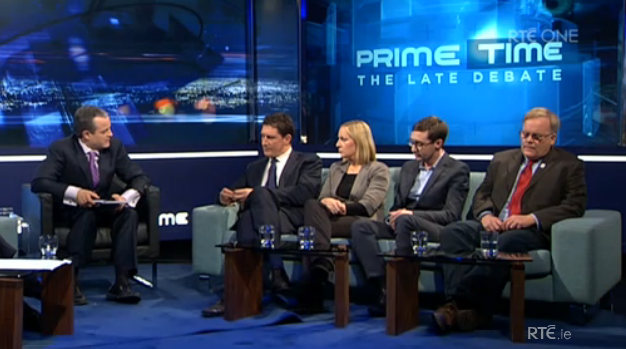
This is an adapted version of a longer essay looking at combining a Propaganda Model based media analysis with a Conversation Analysis approach to analysing news interview interaction. The subject is a series of Prime Time Late Debate programmes which aired in February (and which we looked at at the time), about a month prior to the last election.

Impartiality (often used interchangeably with neutrality) is considered a cornerstone of modern professional journalism. The BBC’s Director of News Helen Boaden recently commented: ‘[BBC] ratings for trust, impartiality and independence have […] continued to rise over the last three years’ and ‘[a]s the perception of trust and impartiality increases, so do our audiences’ because ‘impartiality is an important factor in the audience determining its choice of broadcast news provider’. Similarly, RTÉ state in the introduction to their Programme Standards and Guidelines:

Fundamental to all we do has to be a rigorous commitment to some key editorial principles: Fairness and Honesty; Impartiality; Objectivity and Accuracy; Integrity and Independence; Diversity of Opinion; Respect for the Vulnerable; Accountability

RTÉ is a major provider of the vehicle for public debate. On our airwaves the listening and viewing public should be able to hear all sides of national debate. They should be able to regard the presenters of programmes as neutral and not coming down on one side of an issue of public controversy.

And the guidelines give particular focus to the role of interviewers as arbitrators of debate:

There is a particular onus on programme presenters to be impartial. Presenters should be seen as referees between competing viewpoints, encouraging debate. When an interview is taking place with only one side in a debate represented the presenter may put competing viewpoints to the interviewee.

Looking at two episodes of Prime Time we’re aiming to test whether these rigorous guidelines are realised in the real world and ultimately to ask whether it’s even possible or desirable to demand journalists strive for neutrality. The two programmes we’ll look at were broadcast in the weeks preceding the last general election. The first programme was broadcast on the 3rd February and the second on the 17th February (Late Debate, 3rd Feb) (Late Debate, 17th Feb).

The two panels featured people from all the major parties (Richard Boyd Barrett, Ivana Bacik, Mary Fitzpatrick, Lucinda Creighton, Eoin O’Broin, Eamon Ryan, Michael Mulcahy, Claire Daly, Brian Hayes, Dominic Hannigan), along with non-party affiliated political figures (John McGuirk) and economists and banking experts (Cormac Lucey, Michael Taft, Moore McDowell, Sinead Penthony). While clearly not a representative sample from across the political spectrum (featuring only five women, no trade union representatives, few non-business experts, no political activists and no experts from the social sciences), the predominantly well paid professionals (mainly working in the public sector) that make up the panels do offer some diversity of views on the significant matter under discussion, the Irish economy.

The topics for the programmes were billed as follows, ‘So just how big does your politician think the State should be? What functions should it carry out? And more importantly, what functions should it carry out directly, and what should it just buy in?’ and ‘Can the State really create jobs?’. The central theme of the programmes therefore is the role of government in the economy.

If we were to take the Propaganda Model as a basis we might reasonably argue that despite the presence of these guidelines business friendly discourses of minimal state interference, low tax rates and competitive wages would be disproportionately valued by the interviewer – with these discourses aligning more closely with the interests of corporate advertisers and owners, while also minimising the prospect of negative reactions from powerful sources of flak (e.g. the government). Alternative discourses of high taxation for the wealthy, increases in the minimum wage, proposals for economic stimulus and negotiated write-down on individual and sovereign debt on the other hand would likely provoke these same sources and are therefore likely to be more negatively valued.

Evidence of this predicted preferential treatment of certain discourses is clearly visible in media reporting. Take for example the issue of Ireland’s property bubble and the discourses around the economic measures proposed to deal with its fallout. On the issue of property media reporting is highly biased in favour of discourses of personal responsibility, with the popular refrain being ‘we all partied’. A view held simultaneously by our Minister for Finance and the “newspaper of record”. To emphasise this point it is worth noting that the issue of personal mortgage debt forgiveness took three years to reach the media consciousness. On the issue of Ireland’s economic recovery, austerity measures, as opposed stimulus spending, overwhelmingly dominate media discourse. As we have shown, in the lead up to the first of several emergency budgets in 2009 ‘the [media] debate was […] entirely skewed towards cuts, aimed at increasing ‘competitiveness’ by driving down wages’, alternative budgetary proposals were conspicuous by their absence.

In his recent book Sins of the Father Conor McCabe writes that much media discourse on the economic crisis that has unfolded in Ireland since 2008 has been dominated by myth. There is the myth of the ‘Irish property-owning gene’ where newspaper articles explain the housing bubble of the early 2000’s as a result of a uniquely Irish genetic disposition to home ownership. On the contrary, McCabe cites Eurostat statistics of EU home-ownership in 2006 that placed Ireland eighteenth, with owner-occupancy at ‘just under 74 per cent’ down from a high of 79 per cent in the 1990s. There was also the myth that Ireland’s political and financial establishment have a singular propensity for immoral behaviour. In response to this McCabe simply notes that the financial crisis was not an Irish phenomenon (Near FM interview with Conor McCabe), a fact pointed out for more cynical reasons by successive politicians attempting to deflect attention from their personal responsibility. McCabe though does not make this point to deflect from any individual culpability, he accuses the system, saying: ‘The ruthless pursuit of profit is not personal; that is the way business works. And what is condemned as immoral in times of crisis is often praised as savvy and pragmatic in times of prosperity’.

McCabe could reasonably add to this the myth of Ireland’s ‘bloated’ public sector. Examples of this economic myth are scattered throughout the press. For example, in 2008 Matt Cooper wrote in the UK The Sunday Times newspaper ‘Take the axe to the bloated public sector’. More recently, in March 2011 an analysis piece for the Irish Independent written by Eamon Delaney claimed ‘[a] bloated and pampered public sector is bleeding the nation dry’. However, according to various reports from the OECD (Organisation for Economic Co-operation and Development) in comparison to other OECD countries Ireland’s public sector is relatively small and among OECD countries Ireland ‘ranked third to bottom in terms of public expenditure’ (OECD) (OECD) (Finfacts).

These preferences for certain discourses might be manifested in news interviews in numerous different ways. Failures to attend to characteristics of formal neutrality are potentially as varied as conversation itself. The interviewer may be observed to favour one interviewee over another, whether in the formulation of questions or the time allocated for answers. The interviewer may be found to align with particular panellists in disputes, or to display an apparent preference for certain sources or voices in their questioning, or to deviate from the question-answer organisation, making ‘unvarnished assertions’ in favour of some of the (related) themes discussed here, or their distribution of response tokens (usually withheld in news interviews) may be found to denote approval or disapproval in line with the predictions derived from the Propaganda Model.

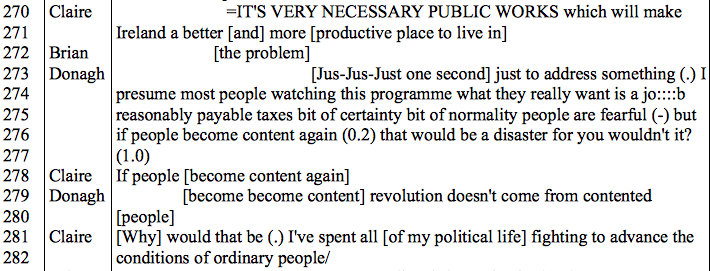
Take for example the following exchanges between Donagh and Claire. Claire is first introduced to the conversation with the comment “you don’t agree with any of this do you?”, “this” referring to an extended discussion between various interviewees and the interviewer in the previous minutes on a range of issues relating to the central question of “equality of opportunity versus equality of outcome”. On the surface this poses a literal binary choice for Claire, restricting her options for response to “yes” or “no”, without that is, diverging from the prescribed interactional frame set by the interviewer in the question. The interactional frame being the organisation of turn taking, broadly characterised as ‘interviewer asks the questions and interviewee answers them’. Interviewees for their part are complicit in their own positioning, implicitly acquiescing to this and other unspoken rules. In effect Claire is forced to reject the premise of the question and risk being perceived as interactionally hostile or accept the premise and appear ideologically intransigent.

It’s worth noting that the question is negatively formulated, as opposed the possible “do you agree with this?”. Also the summation “any of this stuff” is in contrast to much of the economic jargon that had preceded the question, suggesting the interviewee is reflexively opposed to the topic under discussion. Claire is positioned immediately as a hostile witness, an uncooperative partner in the interaction.

We can also see the interviewer diverging from the normal policy of avoiding subjective questioning. The questions are ‘interactionally hostile’, strongly ‘project[ing] preferred or expected responses that run counter to [interviewee] positions’ – as reflected in Claire’s responses. The significance of this exchange in terms of bias is also revealed in Claire’s responses. Claire is one of the few members of the panel that express strong preference for economic stimulus and strong opposition to reducing taxes and increasing financial assistance to stressed banking institutions. Claire is a politically marginal interviewee in terms of economic policy.

Clayman and Heritage refer to the ‘prospective import’ of a question, noting that ‘some questions are relatively open-ended and allow the interviewee maximum leeway to respond, whereas others narrow the parameters of an acceptable response and exert pressure on the interviewee to answer in a particular way’. This is an observation that can be applied to questioning of interviewees in this panel discussion. As shown above, the import of the question posed to Claire certainly narrows her options for response. In the first place she is forced to defend herself against a charge before even addressing the question itself.

If we compare this to the manner in which other interviewee’s are questioned a pattern of interviewee partiality might be observed. For instance:

In all these instances interviewees are directed relatively open-ended questions, with no particular answer preferred in the question. In the case of the question directed at Moore the question itself is prefaced by a contextual statement, formulated as a debate between two opposing sides, of which the interviewer does not express an explicit preference for. However, it could be argued that here too that the interviewer has manufactured a limited number of choices, restricting the interviewee’s options for response.

Again though in the following question we can see again a preference for a particular answer, with Donagh invoking an expert source, adopting the voice of “economists” in order to undermine proposals for a “job creation strategy”:

The significance of this quote is that it is directed at a particular theme or ideology, not a particular interviewee. Donagh does not charge politicians, but “the state”. The issue of job creation is one supported (to different degrees) by almost all the panellists, with the notable exception of Moore (an economist). The concept of a “job creation strategy” is tied up in the discourse of economic stimulus, both suggesting a degree of intervention on the part of the government. By adopting this voice over other potential voices Donagh makes a choice about which discourses are valued. Further, by referring to “economists” he alludes to the presence of economists on the panel, thus embedding the question with an implicit threat – that Brian’s answer is potentially open to direct challenge by experts.

Brian’s response is an objective confirmation of this interpretation. He immediately seeks to position himself in agreement with the identified expert on the panel and with the interviewer’s question, saying “well I agree with Moore”. Of course this is a generous reading of Moore’s remarks. The closest Moore came to endorsing this position was in his opening comment “the state can do things which help jobs to be created”, however he tempered this assertion with the statement “but in the long term the state doesn’t create jobs”. Having positioned himself as a cooperative witness Brian changes tack, after a slight pause and a hesitant “eh but” he goes on to describe how government can create jobs through infrastructure development.

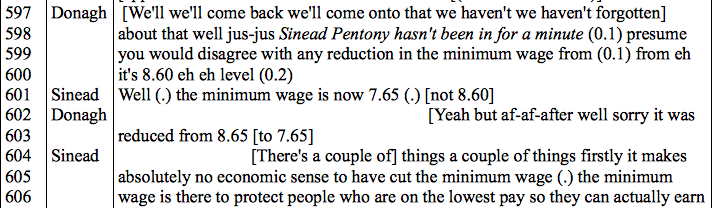
With this exchange in mind it might be interesting to look at interactions between denoted “experts” and the interviewer and fellow interviewees. Sinead Pentony (Head of Policy at TASC, an independent think tank) is first introduced with the comment “I presume you would disagree with any reduction in the minimum wage”, a loaded question similar to that directed towards Claire in an earlier example. It identifies a preferred response, restricting Sinead’s options for answering, without, again, diverging from the interviewer prescribed interaction. It presupposes that Sinead’s contribution is predictable, indicating to the overhearing audience a diminished value of her as yet unstated opinion. It also undermines her position as an expert, positioning her as a reactionary as opposed a rational deliberator of facts. Sinead is, as with Claire, positioned as a hostile witness, an uncooperative partner in the interaction:

Sinead responds to this by reformulating the interviewer’s question. She repairs the premise, noting that the minimum wage is not €8.60, but €7.65. Ordinarily this response would be unnecessary, the accuracy of the wage level is superficial to the fundamental question. However, in responding in this way (including the use of the opening “well”) Sinead indicates that she irritated by the formulation and also reaffirms her position as an expert, displaying precise knowledge of economic intricacies. Donagh responds by admitting his error and apologises in order to repair the relationship. Sinead acknowledges this apology by anticipating his response and beginning her answer to his original question before Donagh has completed his turn.

This interaction becomes more interesting when juxtaposed with interactions between the interviewer and other panel experts, those with ideological views that resonate more closely with the institution hosting the debate. Economists are called upon on various occasions by the interviewer in order to evaluate other interviewee comments. In the following example Donagh summarises the previous turn’s interviewee comments and asks Cormac to evaluate them, asking whether Richard’s proposals are “possible”:

Here Donagh provides a prejudiced summary of Richard’s comments, taking what was a purely ideological discussion (to use Donagh’s words, his “idea of society”) out of context and reframing it as a realistic proposal. Given the condition of Ireland’s government finances, the cost of borrowing and the absence of international investment, plans to “level everybody up” are far fetched at best. This summary positions Richard as a fantasist, and not as a serious political candidate. Cormac inevitably disagrees with the premise and corroborates the interviewer’s tacit proposition.

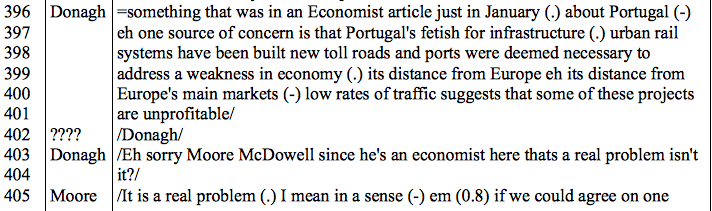
Moore McDowell, an economics lecturer in University College Dublin, is also identified as an expert. Donagh refers to his credentials several times in the course of the programme. In this next example we can see that Donagh seeks confirmation of his views from Moore, saying “that’s a real problem isn’t it”. In the first instance Donagh introduces an article from the current affairs magazine the Economist, satisfying professional requirements for formal neutrality by invoking an argument using the voice of someone else. However he then validates the argument in his question to Moore commenting “that’s a real problem”. He then goes on to modify the statement by adding the words “isn’t it”:

Just as Sinead’s contributions were seen to be predicted, Moore’s contributions are similarly anticipated. However, in contrast to his behaviour towards Sinead, Donagh looks to Moore to validate +his+ views. Donagh addresses Sinead with predictions embedded in the questions. Sinead therefore is not permitted to offer original opinions, she is given the opportunity to validate the interviewer’s position as a knowing overseer. Whereas questions directed at Moore are inflected with hesitance (e.g. “isn’t it”), positioning Moore as an evaluator, a lecturer, to Donagh’s student. Almost an inversion of the turn-granting authority displayed in interactions where interviewees are seen to apply for permission to enter the conversation (e.g. by interrupting with the phrase “Donagh Donagh Donagh”).

Again it is important to recognise that Moore’s views are ideologically congruent with those of the media institution as described by the Propaganda Model. He argues for less government interference in business, a weakening of the trade unions and a broadening of the tax base (which essentially means increasing taxation on the lower income earners as opposed wealthier ones).

On other occasions Donagh can be seen to reuse Moore’s metaphorical queues. Moore refers to the Metro North metaphorically as a “red rag”, indicating that it is project that angers him. Several turns later Donagh assumes this metaphor applying it to another large scale infrastructural project, Dublin Airport’s Terminal 2:

Not only does Donagh adopt Moore’s strong scepticism of using government funds to finance infrastructure development, he also invokes the same metaphor to accentuate the position:

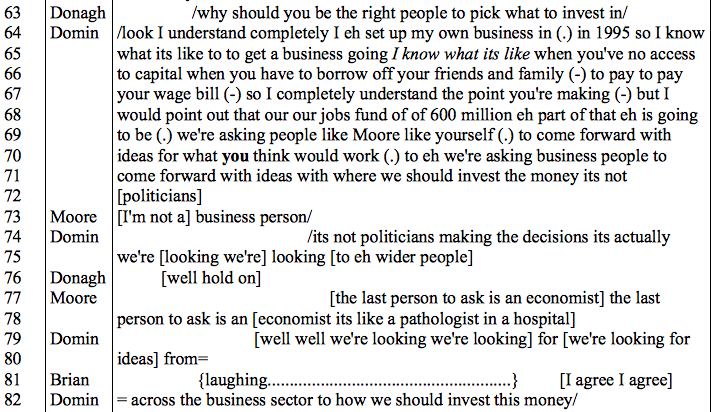
This alignment is reflected by some of the panellists, who, while not agreeing entirely with Moore’s thesis, recognises the appeal of being seen to be walking the same line. However we can see that these alignments can be rejected. For example in the following extract Dominic attempts to align himself with Moore by saying “we’re asking people like Moore”, indicating to the audience that as a non-expert he seeks out the views of experts. However, Moore rejects the alignment in the following turn, interrupting Dominic (and contravening the interviewer-interviewee interactional dynamic) to say “I’m not a business person”. When Dominic does not amend or clarify his statement Moore again interrupts saying “the last person to ask is an economist” to which Dominic responds “we’re looking for ideas from across the business sector”. Donagh attempts to regain control of the discussion, while Brian, who had performed the a similar manoeuvre only moments before without reproach, joins the the interaction laughing at Dominic’s expense:

We can see a similar repetition of interviewee language (i.e. Moore’s “red rag”) in interactions between other panellists and the interviewer. If the following extracts Donagh repeats the interviewee’s phrases in his response to their answers, saying “speaking of madness” and “we’ll get into the staggering and obscene”:

What’s interesting in these repetitions, in contrast to the one related to Moore, is that Donagh appears to change (or invert) it’s discursive application. While Claire uses the the concept of “madness” to  describe “the idea of reducing wages”, Donagh invokes it to describe the idea of negotiated wage agreements. Again Donagh is careful to employ the professional technique of voicing topics as those of others, in this case IBEC (Irish Business and Employers Confederation).

Donagh’s use of voices is interesting too: the IMF (International Monetary Fund), the OECD, IBEC, John Fitzgerald (a researcher at the The Economic and Social Research Institute), the Economist, all strongly business oriented sources. In each instance where these sources are used, Donagh introduces strongly pro-business ideological discourses, such as “cutting the minimum wage” and increasing “[government] expenditure cuts”. While there is substantial conflicting evidence of the effectiveness of these measures Donagh does not attempt to introduce sources or voices that counter this narrative.

Responses tokens (such as “yeah” and “mm”), a common feature of normal conversation, are rarely offered in news interview situations. As Greatbatch notes, the ‘withholding of response tokens’ (in order to avoid signalling approval or disapproval) is a method employed by which interviewers in order to give the appearance of interactional neutrality (Greatbatch in Bell and Garrett, 1998:169). Where they are observed to be offered maybe provide clues as to which views and which panellists the interviewer favours or disfavours.

In both these programmes Donagh is found to strictly adhere to this formal neutralism, withholding verbal response tokens almost entirely, with only several “yeah” tokens used as interviewee turns are closing. A study of body language may reveal inaudible tokens or gestures (such as nodding of the head) that could be construed as signalling agreement / disagreement with prior turns, however this analysis does not attempt to examine this.

In the above extract we can an interviewee, Brian, display how response tokens might be distributed in conversation, even in a heated debate such as this. Donagh on the other hand makes only one interjection during Moore’s lengthy turn. He responds to Moore’s comment regarding government intervention in the business market by saying “which it does all the time”. This is interesting in that it comes at a natural turn-relinquishing point, however it does not provide a further question, it does not indicate to Moore that his turn is closing. It functions instead as an acknowledgement of Moore’s contribution and acts as continuer, indicating to Moore that the floor is still his. It can be thought of therefore as a ‘non-minimal response token’ providing positive ‘feedback’ in assessment of Moore’s prior turn.

The Propaganda Model suggests that business friendly discourses of minimal state interference, low tax rates and competitive wages would be disproportionately valued by the interviewer in these interactions. It also suggests that alternative discourses of high taxation for the wealthy, increases in the minimum wage, proposals for economic stimulus and negotiated write-down on individual and sovereign debt on the other hand would likely be more negatively valued. This analysis has attempted to determine whether this preference for institutionally motivated discursive patterns and the individuals that represent them were manifested in the organisation of the interaction. While not claiming to present a definitive description it has certainly identified some compelling evidence to suggest it’s the case.

Donagh’s interactional relationships with the interviewees are notably different, with Moore continually positioned as the expert and Claire and Richard consistently marginalised. Donagh also shows an identifiable preference for certain sources or voices in his questioning, sources that align with the pro-business predictions made by the Propaganda Model. The analysis has also provided some evidence to suggest the interviewer showed partiality to certain discourses, such as minimum wage cuts and reductions to state expenditure on infrastructure, which again align with the expectations derived from the Propaganda Model.

While Donagh does attend quite rigidly to certain aspects of formal neutrality (e.g. withholding of response tokens) and Prime Time does follows institutional and regulatory guidelines designed to ensure impartiality in news reporting and interviewing there are many opportunities for interviewers to impart their own views or those internalised through the institutional structure.

This observation relates back to ongoing discussions we’ve hosted (Kieran Allen and Robert Jensen) about the practicality of striving for neutral journalism and whether comprehensive guidelines simply mask advocacy with (not so) carefully managed language.

Twitter Media List

For anyone interested in media analysis I’ve put together this list of journalists and editors on Twitter. The list is about 450 tweeters long at present, but I’ll be continually adding more as I find them. The majority are UK journalists, but there’s a good number of Irish and prominent US ones in there too. See what you can do with it.